Figure 1 - Flowchart of the first and second bibliographic analysis.
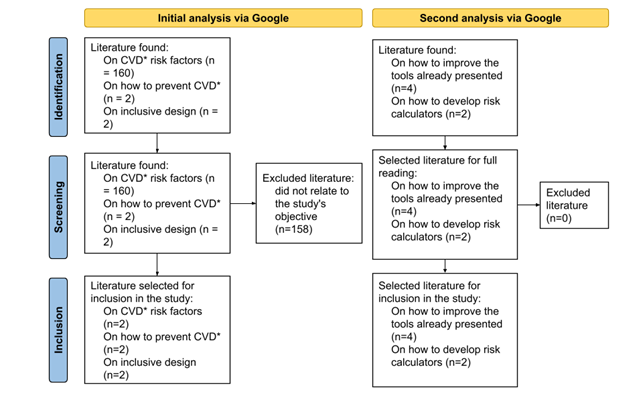
Note: CVD* - Cardiovascular disease
Source: prepared by the authors
EXPERIENCE REPORT
DEVELOPMENT OF A MOBILE APPLICATION FOR THE PROMOTION OF CARDIOVASCULAR HEALTH IN THE ELDERLY: A EXPERIENCE REPORT
DESAROLLO DE UNA APLICACIÓN MÓVIL PARA LA PROMOCIÓN DE LA SALUD CARDIOVASCULAR EN ANCIANOS: UN RELATO DE EXPERIENCIA
DESENVOLVIMENTO DE UM APLICATIVO MÓVEL PARA PROMOÇÃO DE SAÚDE CARDIOVASCULAR EM IDOSOS: UM RELATO DE EXPERIÊNCIA
https://doi.org/10.31011/reaid-2026-v.100-n.1-art.2528
1Yasmin Narciso Venancio
2Raissa Rafaela Loos
3Amanda Fidelix
4José de Siqueira Amorim Júnior
1Instituto Federal de Santa Catarina, Joinville, Brazil. Orcid: https://orcid.org/0009-0009-7683-577X
Instituto Federal de Santa Catarina, Joinville, Brazil. Orcid: https://orcid.org/0009-0006-4806-4881
3Instituto Federal de Santa Catarina, Joinville, Brazil. Orcid; https://orcid.org/0009-0008-5863-1178
4Instituto Federal de Santa Catarina, Joinville, Brazil. Orcid: https://orcid.org/0000-0002-3401-5417
Corresponding Author
Yasmin Narciso Venancio
rua Rui Barbosa, n° 1265, Joinville - SC – Brazil. Phone: +55 (11)94755-9115, E-mail: yasmin.n2003@aluno.ifsc.edu.br
Submission: 24-03-2025
Approval: 17-12-2025
ABSTRACT
Objective: To report the experience of nursing students in implementing an extension project aimed at developing an application for monitoring cardiovascular health in the elderly. Method: This is an applied study of technological development, presented as an experience report, whose methodology was based on User-Centered Design, with bibliographic research and testing of the application with 16 elderly individuals and 8 healthcare professionals. These participants analyzed the application based on its usability, clarity, and content relevance. The development process included a situational diagnosis using DATASUS, prototyping in Canva, and modeling in AppGyver. Results: The progress and initiative of the application are focused on the prevention of cardiovascular diseases among the elderly and emphasizing risk factor control, besides encouraging the adoption of healthy habits. During the application testing phase, the participants demonstrated an understanding of the presented content along with the support of the team. Final Considerations: The development of the “Pulse+” application, by generating a tool focused on the cardiac health of the elderly, highlights the potential of technology in promoting the prevention of cardiovascular diseases through health education and self care.
Keywords: Cardiovascular Diseases; Elderly; Mobile Application; Health Education.
RESUMEN
Objetivo: Reportar la experiencia de estudiantes de enfermería en la implementación de un proyecto de extensión orientado al desarrollo de una aplicación para el monitoreo de la salud cardiovascular en ancianos. Método: Se trata de un estudio aplicado de desarrollo tecnológico del tipo relato de experiencia, cuya metodología se basó en el Diseño Centrado en el Usuario, con investigaciones bibliográficas y pruebas de la aplicación con 16 personas mayores y 8 profesionales de la salud, quienes analizaron la aplicación en función de su usabilidad, claridad y relevancia del contenido. La construcción incluyó un diagnóstico situacional mediante DATASUS, prototipado en Canva y modelado en AppGyver. Resultados: El progreso e iniciativa de la aplicación se centraron en la prevención de enfermedades cardiovasculares en personas mayores, con énfasis en el control de los factores de riesgo y en el fomento de la adopción de hábitos saludables. Los participantes en la fase de prueba de la aplicación demostraron comprensión del contenido presentado, con la ayuda del equipo. Consideraciones Finales: El desarrollo de la aplicación “Pulse+”, al generar una herramienta orientada a la salud cardíaca de las personas mayores, demonstra el potencial que posee la tecnología para la promoción de la prevención de enfermedades cardiovasculares mediante la educación en salud y el autocuidado.
Palabras-clave: Enfermedades Cardiovasculares; Ancianos; Aplicación Móvil; Educación en Salud.
RESUMO
Objetivo: Relatar a experiência de acadêmicos de enfermagem na implementação de um projeto de extensão voltado ao desenvolvimento de um aplicativo para monitoramento da saúde cardiovascular em idosos. Método: Trata-se de um estudo aplicado de desenvolvimento tecnológico do tipo relato de experiência, cuja metodologia foi baseada no Design Centrado no Usuário, com pesquisas bibliográficas e testagem do aplicativo junto a 16 idosos e 8 profissionais de saúde, que analisaram o aplicativo com base em sua usabilidade, clareza e relevância do conteúdo. A construção envolveu diagnóstico situacional via DATASUS, prototipagem no Canva e modelagem no AppGyver. Resultados: O progresso e iniciativa do aplicativo concentraram-se na prevenção de doenças cardiovasculares entre os idosos, com ênfase no controle de fatores de risco e no incentivo à adoção de hábitos saudáveis. Os participantes da etapa de teste do aplicativo demonstraram compreensão do conteúdo apresentado, com o auxílio da equipe. Considerações Finais: O desenvolvimento do aplicativo “Pulse+”, ao gerar uma ferramenta direcionada à saúde cardíaca dos idosos, demonstra o potencial que a tecnologia possui para promoção da prevenção de doenças cardiovasculares através da educação em saúde e autocuidado.
Palavras-chave: Doenças Cardiovasculares; Idoso; Aplicativo móvel; Educação em Saúde.
INTRODUCTION
Over the years, advances in medical treatments and improvements in health systems have significantly increased life expectancy(1). As a result, the elderly population has grown considerably. In Brazil, for example, the number of elderly people has grown by 57.4% since 2010(2). However, healthcare in Brazil faces a significant challenge, as most efforts are focused on treating diseases, while prevention receives less attention(3). These conditions increase the vulnerability of this population to developing diseases, especially cardiovascular diseases. With aging, the prevalence of these diseases among the elderly is becoming increasingly significant, constituting one of the main causes of morbidity and mortality in this age group(4). Cardiovascular diseases compromise the functioning of the heart and blood vessels, and can lead to serious complications such as heart failure, myocardial infarction and stroke(5). In this context, it is observed that investments are more directed towards the treatment of heart disease than towards the effective prevention of risk factors(6), and, as a result, many of these cases are not reversed, leading to the death of these individuals. This scenario is evidenced by data from the Mortality Information System (SIM), available on the DATASUS website, which indicate the occurrence of 325,256 deaths of elderly people annually due to these diseases(7), highlighting the inadequacy of health promotion and risk control strategies to reduce cardiovascular mortality in this population. In the local context, in 2022, 772 deaths of individuals aged between 60 and 80 years or older were recorded in the city of Joinville due to causes related to the circulatory system, such as myocardial infarction and heart failure(7). These numbers, both nationally and municipally, reinforce the urgent need for effective public policy strategies aimed at prevention, early detection and continuous monitoring of cardiovascular diseases, especially in the face of population aging(8).
Given this scenario, actions to promote cardiovascular health, anchored in health education, become essential, as they go beyond the dissemination of information on prevention, in addition to encouraging self-management of health, empowering patients to understand their condition and adopt healthy habits in their daily lives(9). In this same perspective, despite the barriers associated with low familiarity with technological resources and social inequalities that contribute to the increase in digital illiteracy(10), the development of a mobile application with an accessible interface can contribute to access to knowledge and interaction(11). Furthermore, it is a strategy to facilitate interaction between health professionals and users, as well as to optimize data organization and management stages, given the amount of information that an application can store, and this can be useful when implementing health strategies in the SUS(12). It is estimated that around 93% of Brazilian households have mobile devices, which highlights the reach that such devices can offer to the health system(13). Given this context, the justification for this study is based on the need for investments in technologies focused on health prevention, with an emphasis on mobile devices and applications that assist in the early detection, monitoring, and control of cardiovascular risk factors within the Unified Health System (SUS), which currently serves approximately 23.03 million elderly people, according to IBGE data cited by the Ministry of Health in a 2025 survey(14). However, the sector still lacks modernization to effectively meet such a significant demand. Amid this scenario, nursing students belonging to the project, recognizing the need for strategies to address the problem observed in Joinville, decided to develop a cardiovascular risk monitoring application. This initiative aims to provide continuous monitoring of the health of the elderly, as well as promote their inclusion in the digital world(11).
Given the above, this study aims to report the experience of undergraduate students in Nursing at the Federal Institute of Santa Catarina (IFSC) during the execution of an extension project, funded by the Student Leadership Grant (No. 12/2024/DIREX-PROEX).
METHODS
This is an experience report study, based on the authors' experiences as participants in the "Heart in the Palm of Your Hand" project, which developed an application aimed at preventing cardiovascular diseases in the elderly. The program was developed over two months, from September 30 to November 29, 2024, following the User-Centered Design method in a participatory approach, which is more advantageous for the target audience(11). In this process, users were occasionally involved during the application's design, which allowed for the identification of possible irregularities and facilitated the interaction of the elderly with the technology. To ensure the project's progress, six stages were considered: (1) First analysis, (2) Design, (3) Testing, (4) Second analysis, (5) Maintenance and (6) Implementation(15). The initial analysis began by identifying the problem in the municipality through the DATASUS platform, highlighting a critical scenario of cardiovascular diseases among the elderly. Given this context, the creation of an application specifically designed for this population was proposed as a possible solution. Also in this stage, the team conducted a two-phase bibliographic research study to ensure that the technology was accessible and suitable for the cognitive and sensory needs of the elderly.
It is important to highlight that, once the research objective is defined, it becomes essential that researchers establish a guiding question to guide the bibliographic investigation (16). In this sense, the first search was structured from three main questions due to the distinct approaches that make joint analysis impossible through a single central question. Thus, each question corresponds to a specific axis, allowing for a more consistent and contextualized investigation: (1) "What are the main factors that contribute to the development of cardiovascular diseases in the elderly?" (2) "What strategies are most effective in preventing these factors?" and (3) "What is the most appropriate design for applications aimed at the elderly?". Below is the research flowchart.
Figure 1 - Flowchart of the first and second bibliographic analysis.
Note: CVD* - Cardiovascular disease
Source: prepared by the authors
The research was
conducted using the Google search engine, since the group's objective was not
exclusively to locate publications in indexed databases, but rather to reach a
wider range of sources. Therefore, literature available on government and WHO
websites was also considered. Furthermore, the search did not require the
addition of boolean operators, since Google already considers these as added(17).
The keywords searched were related to their respective questions and
always followed by the word “article”: (1) “risk factors for cardiovascular
diseases”; (2) “exercise as prevention of risk factors” and “diet as prevention
of risk factors”; and (3) “inclusive design in an application for the elderly”.
The search results were then synthesized and organized into tables in Google
Docs, represented by Table 1.
This information served as the basis for the development of an initial prototype on the Canva platform during the project conception phase. The app's structure was based on this prototype, while its modeling was done on the AppGyver platform, which specializes in software development. Simultaneously, also at this stage, informational brochures were created on the Canva platform, with the aim of presenting the technology to the target audience. Based on this, tests were conducted with a group of 16 elderly individuals, aged 60 or older, participating in the extension project "Access to Technologies in Old Age," carried out by the Federal Institute of Santa Catarina, Joinville campus, and funded by the Proex 03/2024 grant. Initially, three visits were planned, during which, on the first visit, brochures were distributed to the elderly individuals who subsequently used the tool with the assistance of the development team.
On the second visit, a questionnaire developed using Google Forms was applied, the objective of which was to collect feedback regarding ease of use, clarity of information, and relevance of content in order to improve the application and keep it adequate in relation to the public's suggestions. This measurement instrument was adapted from an existing questionnaire (18). In addition, similar questions were directed to health professionals who teach on campus, with the aim of judging the application from the perspective of professional care. To improve the program, further bibliographic research focused on implementing improvements was necessary, the results of which are summarized in Table 2.
Thus, the guiding questions for this stage were formulated based on the demands identified in user responses, and, again, due to their different emphases, two questions were retained for further analysis: (1) “How to improve the presentation of habit tracking tools?” and (2) “How to develop risk accounting calculators?”. Respectively to their corresponding questions and always followed by the word “article”, the keywords searched were: (1) “risk calculators” and (2) “BMI and diabetes mellitus”, “cardiovascular diseases and diabetes mellitus”, “minimum time for exercise” and “Brazilian hypertension guidelines”. With the results of this investigation, the final adjustments were implemented in the application during the maintenance stage.
To make the tool more accessible, the team produced explanatory videos on YouTube, through the “Pulse+” channel, detailing the step-by-step process of each application function. During the implementation phase, the technology was made available in Android Application Pack (APK) format, being compatible exclusively with devices operating on the Android system. In addition, the software was promoted on the institution's official website, with the aim of raising awareness about heart health and promoting digital inclusion among senior citizens.
RESULTS
The following presents the results obtained from the first bibliographic research carried out by the team. The data summarized in Table 1 summarize the main characteristics of the publications analyzed, including everything from the title to the main results.
Chart 1 - initial literature review
|
Title |
Authorship |
Plataform |
Magazine |
Main results |
|
1 Regarding inclusive design |
|
|||
|
Usability and accessibility recommendations for mobile phone interfaces aimed at the elderly. |
Anjos, Gontijo (2015) |
Scielo |
Production |
Do not leave icons without descriptions; avoid screen scrolling; use a large, high-contrast font; do not include information in English. |
|
Inclusive graphic design for senior citizens. |
Farias, Landim (2019) |
Scielo |
Human Factor in Design |
Differentiation of letters within the same font (9 and g, 0 and o, l and l, c and o); simplified images and icons; dark blue, yellow, green, and brown are colors that visually impaired elderly people can see. |
|
2 Regarding risk factors for developing CVDs* |
|
|||
|
Analysis and prevalence of cardiovascular diseases and associated factors in the elderly, 2000-2010 |
Massa. Duarte, Chiavegatto Filho (2019) |
Scielo |
Ciência & Saúde Coletiva |
Older age group; presence of diabetes and hypertension; history of smoking; income less than three minimum wages. |
|
Prevalence and co-occurrence of cardiovascular risk factors in elderly participants of a population-based study in southern Brazil. |
Medeiros et al (2019) |
Scielo |
Revista Brasileira de Epidemiologia |
Low education level; alcoholism; smoking; inadequate diet; insufficient physical activity; obesity; hypertension; low income. |
|
3 Regarding the prevention of CVDs |
|
|||
|
Cardioprotective diet |
Ministry of Health (2018) |
GOV |
- |
Eat more natural foods (vegetables, legumes); moderate carbohydrates (bread, rice); reduce fatty foods (meat, homemade sweets). |
|
Effects of physical exercise on cardiovascular risk and quality of life in hypertensive elderly individuals. |
Cassiano et al (2020) |
Scielo |
Ciência & Saúde Coletiva |
Exercise results in positive changes in CVD* risk factors |
Note: CVD* - cardiovascular disease
Source: Prepared by the authors.
The sample includes 6
published articles between 2015 and 2020, of which 1 article (17%) is from
2015, 3 (50%) are from 2019, 1 (17%) is from 2018, and 1 is from 2020 (17%).
Additionally, 5 articles (83%) were found on SciELO and 1 (17%) on the
government platform, called GOV. Following the initial literature review, the
team used the information obtained to define the main monitoring
functionalities of the application, which include "exercise,"
"medication," "nutrition," and "vital signs."
These sections were structured in a practical and accessible way,
addressing the essential aspects for promoting cardiac health in the elderly.
Based on these findings, the "emotions" section, conceived at the
beginning of the project before the bibliographic research, was maintained as a
complementary tool. Furthermore, the team considered the implementation of a
login screen relevant, allowing each user's data to be stored exclusively on
their devices, ensuring greater privacy and security of information.
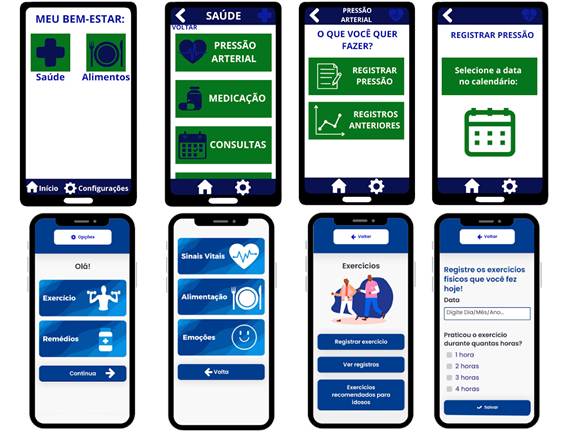
Based on bibliographic research, the functionalities were defined, and the team carefully selected the app's color palette, opting for dark blue and white to ensure high contrast for better readability. Similarly, images with minimal detail and a flat design were chosen to illustrate sections such as "exercises," "medications," "nutrition," "vital signs," and "emotions," as well as the main menu buttons, aiming to facilitate user navigation.
Considering that the target audience is composed of elderly Brazilians, the language adopted was exclusively Portuguese. The app was named "Ritmo Certo" (Right Rhythm). The image below compares the initial prototype with the first version of the app, highlighting the aforementioned aspects.
Image 1 - Comparison between the prototype (first line) and the first version of the application (second line)
After the project was completed (second stage), the third stage (testing) began, in which the data collection from the questionnaires was only completed on the third attempt. Therefore, the absenteeism rate was calculated considering only those present, resulting in an average of 44.6%.
Table 1 – Feedback from seniors participating in the “Access to
Technology in Old Age” project, Joinville – SC, Brazil
|
Variables |
Agree (%) |
Disagree (%) |
Abstention (%) |
|
1 Regarding ease of understanding |
|||
|
1.1 From the information provided by the application |
50 |
- |
50 |
|
1.2 From the app images |
37,5 |
- |
62,5 |
|
1.3 From the registration page |
- |
100 |
- |
|
2 Regarding the design |
|||
|
2.1 The colors used have good contrast. |
50 |
- |
50 |
|
2.2 The letters used in the application are of the appropriate size and type. |
50 |
- |
50 |
|
3 Regarding the objectives |
|||
|
3.1 The app contains information that is frequently used in everyday life. |
25 |
- |
75 |
|
3.2 The app encourages behavioral change. |
75 |
- |
25 |
Source: prepared by the authors
The questionnaire directed at healthcare professionals obtained a total of eight responses. In addition to the selectable options, a descriptive field was included at the end, allowing for additional suggestions. The most frequent responses were: "strongly agree" (average of 62.5%), followed by "partially agree" (23%), "partially disagree" (4%), and finally, "strongly disagree" (1.3%), in addition to the suggestions included in the descriptive field. Of the eight responses received, five included descriptive comments, contrasting with an abstention rate of 37.5% for this field.
Among the main observations made by the professionals, the following stand out: the absence of a user feedback system, since the application only offered a note-taking functionality (mentioned twice); criticism of the application's name, as the term "correct" could generate stigmatization (mentioned once); lack of image descriptions in the "emotions" section (mentioned twice); and the suggestion to include more selectable options, replacing some text fields (mentioned once).
Table 2 – Feedback from healthcare professionals, Joinville – SC, Brazil
|
Variables |
SD (%)* |
PD (%)** |
PA (%)*** |
SA (%)**** |
|
1 Regarding the objectives |
||||
|
1.1 They are suitable for the needs of the elderly. |
- |
12,5 |
37,5 |
50 |
|
1.2 It is useful for monitoring heart health in the elderly. |
- |
- |
12,5 |
87,5 |
|
1.3 Encourages self-care and health management in older adults. |
- |
- |
25 |
75 |
|
2 Regarding language |
||||
|
2.1 The app's name is fitting for its purpose. |
12,5 |
- |
12,5 |
75 |
|
2.2 The vocabulary used is accessible and appropriate for the elderly. |
- |
- |
12,5 |
87,5 |
|
2.3 The descriptions provided are sufficient for the proper use of the application. |
- |
- |
62,5 |
37,5 |
|
3 Regarding relevance |
||||
|
3.1 It addresses aspects relevant to promoting heart health in the elderly. |
- |
- |
- |
100 |
|
3.2 The content and themes covered are current and important. |
- |
- |
12,5 |
87,5 |
|
3.3 It can be used as a health education tool. |
- |
- |
25 |
75 |
|
4 Regarding the design |
||||
|
4.1 The icons and buttons have clear descriptions that make navigation easy. |
- |
- |
25 |
75 |
|
4.2 Images in the app are relevant to the content. |
- |
- |
- |
100 |
|
4.3 The images express the information that was intended to be conveyed. |
- |
12,5 |
12,5 |
75 |
|
4.4 The images make using the app intuitive. |
- |
- |
37,5 |
62,5 |
|
4.5 The font and letter size in the app are suitable for seniors. |
- |
- |
12,5 |
87,5 |
|
4.6 The colors used are contrasting, making them easier to read. |
- |
- |
- |
100 |
Note: *SD – strongly disagree; **PD – partially disagree; ***PA – partially agree; ****SA – strongly agree
Source: prepared by the authors
Although most responses during the testing phase were positive, adjustments to the prototype became necessary to improve the user experience, which led to a second literature review (fourth stage), the results of which are presented below.
Chart 2 - Second analysis of the literature
|
Title |
Authorship/year |
Plataform |
Magazine |
Main results |
|
||||
|
1 To develop a risk calculator |
|
|
|||||||
|
Translation and cross-cultural adaptation into Brazilian Portuguese of the Finnish Diabetes Risk Score (FINDRISC) and reliability assessment. |
Barim, et al (2020) |
Scielo |
Revista Brasileira de Epidemiologia |
Stratification and identification of the risk of developing DM* in the next 10 years. |
|
||||
|
Framingham Global Risk Scale (ERG) |
Ministry of Health (s.d.) |
GOV |
- |
Stratification and identification of the risk of developing CVD** in the next 10 years. |
|
||||
|
2 To improve the app's presentation |
|
|
|||||||
|
Body mass index and abdominal circumference: association with cardiovascular risk factors. |
Rezende et al. (2006) |
Scielo |
Arquivo brasileiro de cardiologia |
Body mass index relates weight and height; excess weight overloads the heart, raises blood glucose levels, and reduces HDL, promoting atherosclerosis. |
|
||||
|
Cardiovascular disease in diabetes mellitus: analysis of classic and non-classic risk factors |
Siqueira, Almeida-Pititto, Ferreira (2007) |
Scielo |
Arquivos brasileiros de endocrinologia & metabologia |
DM* increases the risk of developing cardiovascular diseases (CVDs) because hyperglycemia increases insulin resistance and causes damage to blood vessels, leading to atherosclerosis and hypertension. |
|
||||
|
WHO guidelines for physical activity and sedentary behavior at a glance |
WHO (2020) |
WHO (World Health Organization) |
- |
Healthy older adults and those with chronic conditions should engage in at least 150 minutes of moderate-intensity physical activity. |
|
||||
|
2 To improve the app's presentation |
|||||||||
|
Brazilian Guidelines for Blood Pressure Measurement Inside and Outside the Doctor's Office - 2023 |
Feitosa et al (2024) |
Scielo |
Arquivos Brasileiros de Cardiologia |
For individuals over 18 years of age, blood pressure above 140/90 is considered hypertension; measure after resting for 5 minutes, with an empty bladder; having not consumed coffee, energy drinks, alcoholic beverages, or eaten for at least 30 minutes, and not having exercised for at least 90 minutes; keep your arm at heart level, legs uncrossed, and remain seated. |
|||||
|
Update of the Cardiogeriatrics Guidelines from the Brazilian Society of Cardiology |
Feitosa et al (2019) |
Sociedade Brasileira de Cardiologia |
- |
HR*** basal target < 110 bpm**** |
|||||
Note: DM* - Diabetes mellitus; CVD** - cardiovascular disease; HR*** - heart rate; bpm**** - beats per minute
Source: prepared by the authors
In this phase, 6 literature sources were obtained, of which 4 are from Scielo (67%), 1 (17%) is from GOV and the last (17%) is from WHO. The sample dates between 2006 and 2024, and one of the literature sources does not have a date.
The fifth stage (maintenance) was divided into three phases, the first of which was dedicated to removing certain functionalities to improve the user experience. The following were removed: (1) the "emotions" section, due to the difficulty the target audience might have in understanding it because of the lack of descriptive elements in the images; (2) the login screen, due to the difficulty elderly people have in remembering their access passwords, in addition to the fact that the information is already stored directly on the user's device, eliminating the need for this additional step, which could hinder use; and (3) the list of medications in the corresponding section, as it caused confusion among users, who frequently could not find their medications in the predefined list.
In the second phase of the fifth stage, new mechanisms were implemented in the application. The first of these was a feedback system to reinforce user awareness when saving information. Whenever an inappropriate habit is recorded, a message appears recommending a change in that behavior. On the other hand, when reporting a healthy practice, the user receives an encouraging message. This feature was applied to the food sections, to identify the absence or insufficient consumption of natural foods; vital signs, to alert about increased heart rate and blood pressure; and exercise, to indicate when exercise time is insufficient.
In addition, Body Mass Index (BMI), Cardiovascular Risk (based on the Framingham score), and Diabetes Risk Assessment (using the Finnish score) calculators were incorporated, along with additional information on the relationship between BMI, diabetes, and the development of cardiovascular disease. To make it more accessible to older adults and avoid information overload, technical measurements such as mg/dL for cholesterol and mmHg for blood pressure were omitted.
Other improvements included more time options in the exercise tab, allowing for more accurate recording of the duration of physical activities, and guidance on blood pressure measurement.
In the third phase of the fifth stage, several updates were made to improve the usability and visual identity of the application. The improvements included updating the images for each section and the icons, as well as renaming the application from “Ritmo Certo” to “Pulse+” in response to concerns about potential stigmatization. Simultaneously, the logo was redesigned to reflect the new visual identity.
Other modifications involved replacing the "meal description" option in the food section with selectable boxes, since the target audience demonstrated difficulties in manually entering information. The same approach was applied to the exercise section, where selection mechanisms were added to facilitate user interaction.
Furthermore, a technical flaw that prevented saving information in the "dinner" option, whose selection box was inactive, was corrected, thus ensuring the correct functioning of the feature. Some of these corrections are illustrated in the image below.
Image 2 - Comparison between the first version of the application (first line) and the second version (second line)
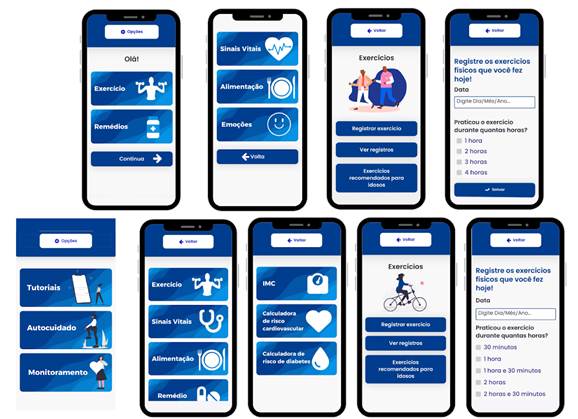
Source: Authors' archives, 2024
Finally, in the sixth and final stage, the team released the application on the social media of the Federal Institute of Joinville Campus, with the aim of increasing its visibility and attracting new users. In addition, an article about the project was published on the IFSC website in 2025, detailing the origin and objectives of the initiative(19). Explanatory videos were also produced on YouTube, through the official Pulse+ channel(20), which demonstrate how to install the application, in addition to other informative videos not publicly listed, which can be accessed in the “Tutorials” section within the application itself.
DISCUSSION
The advancement of technology has revolutionized the application of strategies in health, presenting itself as a powerful tool to expand the reach and effectiveness of interventions. Its ability to reach different audiences in an accessible way represents a significant advantage that health professionals can exploit to optimize the promotion of well-being and the prevention of diseases. The use of these technologies in health is called mHealth, and is not only related to cell phones, but also tablets and video game consoles(21). However, although there are some applications in circulation in the country, such as “Meu SUS Digital”, the high cost associated with their implementation, added to the government regulatory requirements, hinders both the development and the expansion of the use of these tools. As a result, their incorporation into the Unified Health System (SUS) faces significant challenges(22).
Despite this impasse, it is essential that more software developed by nurses be integrated into primary care. The increase in cardiovascular diseases in the elderly highlights the importance of nurses in implementing risk reduction strategies, as well as stimulating self-awareness and autonomy in this population. This approach not only strengthens the bond between nurses and the community, but also emphasizes the unique role of nursing care in health promotion and disease prevention.
From this perspective, this study developed and evaluated the content and interface of a mobile application aimed at preventing heart disease in the elderly. To ensure the platform's suitability to the needs of the target audience and the guidelines in the literature, content validation was carried out with elderly people and experts, following a recommended approach to ensure the usability and effectiveness of the tool(23).
Interventions for managing risk factors related to inadequate diet were based on recommendations from the Ministry of Health, as presented in Table 2, which highlight the importance of a balanced diet, encouraging increased consumption of natural foods and moderation in the intake of carbohydrates and fatty foods. In this regard, there is a study(24) that agrees with the above, emphasizing that the consumption of vegetables prevents chronic diseases.
These guidelines were incorporated into the app in a manner similar to the playful approach of the Cardioprotective Diet Manual, providing users with a color-coded system to facilitate understanding. The groups were represented by blue, yellow, and green, corresponding, respectively, to food categories such as meats, breads, and vegetables. This strategy gave the “Nutrition” section an interactive dynamic, making the guidelines more accessible and facilitating the elderly's adherence to healthy eating habits. On this perspective, a study(25) says that, in a manner analogous to that implemented in the app, diagrams with pictures are more efficient for the understanding of the elderly.
Similarly, the physical exercise instructions available in the “Exercises” section of the app include recommendations focused on balance and muscle strengthening activities, as well as emphasizing the importance of stretching before performing these practices. In this sense, “Pulse+” presents guidelines aligned with those of another tool aimed at the elderly, the Active Senior app, reinforcing the relevance of physical activity in promoting health and preventing cardiovascular complications(26). However, while “Active Senior” organizes exercises into difficulty levels and offers demonstration videos to assist in execution, “Pulse+” does not have this format, which may impact how users assimilate and perform the movements. Even so, the “Pulse+” proposal seeks to ensure accessibility and understanding through direct instructions and simplified language.
In the context of developing technologies aimed at the health of the elderly, several approaches can be adopted to ensure both usability and integration with health professionals. In this sense, in another study that focused on the development of a prototype with a similar purpose(27), this concern led to the creation of two versions of the application: one for health professionals, with greater control over the data, and another for the elderly, with restricted access to some changes. On the other hand, “Pulse+” differs by adopting a single version of the application, focused on health education from the perspective of self-care, since, by receiving information about the factors that contribute to the development of cardiovascular diseases, the population has a greater capacity to adopt preventive measures and manage their own well-being(28). In this way, the elderly themselves record and monitor their information, which can be shared with health professionals during consultations. Even without a version exclusively for professionals, “Pulse+” contributes to monitoring daily habits and vital signs by providing health records that help identify patterns and compensate for possible oversights on the part of the elderly. This functionality facilitates communication between patient and professional, making consultations more assertive and effective.
To manage risk factors associated with smoking, diabetes, hypertension, and obesity, cardiovascular risk calculators, diabetes risk calculators, and BMI calculators were added. Because older adults have reduced functional capacities(29), instructions on how to use the calculators were written in simple language to facilitate understanding, as well as information on how these risk factors are related to the development of cardiovascular diseases.
The feedback system has also become extremely important for promoting self-care, which is a process that does not depend solely on the individual, but also requires the support of health institutions, demonstrating that messages that highlight good habits, or encourage change, represent a form of support for the elderly(30).
The current medication section aims to allow users to record their medication use. However, future versions of the app could incorporate alarms and notifications to remind users of the exact time for each dose, helping with treatment adherence and preventing potential forgetfulness.
During the implementation phase, the application was scheduled to be made available on the Google Play Store, the official app store for Android devices. However, Google requires detailed justifications for the use of certain permissions, such as access to the camera and photo gallery. Although the application did not use these functionalities, its coding was already pre-defined, as it was developed on a low-code platform that does not require manual programming. As a result, the incompatibility with the store's guidelines led to the application being rejected for publication.
During the testing phases, one of the main challenges was the low return rate from participants after the first visit, making it difficult to obtain feedback. Many elderly people reported that they did not receive sufficient guidance during their first interaction with the application, resulting in a negative initial experience and disinterest in using the tool.
Furthermore, during the second visit, it was observed that most of the elderly chose not to provide their opinion, which compromised the collection of feedback. As a consequence, the data could only be collected on the third visit. This problem was attributed, in part, to the absence of some participants in the classes where the visits were scheduled. On the other hand, the lack of interest in the application was also a determining factor in the non-participation of a large part of those present.The QR code in the informational brochure, intended to facilitate access to the app installation, was not accessed by some of the elderly participants. Many did not know how to scan it or had phones that did not perform automatic reading, requiring the installation of an additional app for this function. Furthermore, even with the team's support, if the smartphone was incompatible with the APK file — available exclusively for Android devices, reading the code would not guarantee the successful installation of “Pulse+”, making the process even more challenging for some users.
In the form intended for healthcare professionals and professors of the Bachelor's Degree in Nursing at the Federal Institute, a reluctance to download the application was observed due to its APK format. This barrier directly impacted participant engagement, resulting in a lower response rate to the form and, consequently, hindering the collection of feedback.
Although bibliographic research has identified screen scrolling as an inclusive design problem, it was not possible to eliminate it in the note storage and calculator sections due to technical limitations. Following this same perspective, feedback from healthcare professionals was incorporated, who recommended removing the manual date entry option. However, in this version of the application, it was not possible to completely exclude the descriptive options related to dates, as the platform used for the development of the mobile technology did not offer viable alternatives for this modification.
This application may not fully meet the needs of all users, especially elderly people with total vision loss, illiterate people, or elderly people from other countries, since the software is only available in Portuguese. However, its use can be facilitated with the help of a family member or caregiver. Furthermore, to make the tool more accessible, future versions could incorporate audio description mechanisms, allowing essential information to be conveyed audibly, thus expanding its usability for this audience.
The initial proposal aimed at developing a mobile technology capable of promoting self-care and facilitating the monitoring of lifestyle habits that influence the cardiovascular health of the elderly, contributing to the prevention and management of risk factors. “Pulse+” encompasses the main aspects that guarantee its accessibility for the majority of the target audience, fulfilling the central objective of the project.
CONCLUSION
This study enabled the development of the "Pulse+" application, a tool aimed at promoting cardiovascular health in the elderly. The technology provides information on risk factors, guidance on their management and monitoring, as well as interactive calculators that assist in the self-management of these risks.
Despite the challenges faced, such as initial resistance from participants during the testing phase, the positive results obtained highlight the relevance of the approach adopted. The implemented adjustments demonstrated significant potential to improve the user experience, making the technology more accessible and intuitive. Furthermore, these improvements contribute to facilitating the adoption of the application in the daily lives of the elderly, promoting more efficient use aligned with their needs. These results reinforce the importance of expanding initiatives that promote digital inclusion and health education for the elderly population. With continuous improvements, it is expected that this technology can be incorporated into health services, strengthening self-care and optimizing the care provided, reaffirming the importance of investing in health-oriented technologies, contributing to a more efficient, integrated, and user-centered system.
REFERENCES
1. Buss P, Hartz Z, Pinto LF, Rocha CMF. Promoção da saúde e qualidade de vida: Uma perspectiva histórica ao longo dos últimos 40 anos (1980-2020). Cien Saude Colet [Internet]. Maio 2020 [citado 2025 Nov 17]. Disponível em: http://cienciaesaudecoletiva.com.br/artigos/promocao-da-saude-e-qualidade-de-vida-uma-perspectiva-historica-ao-longo-dos-ultimos-40-anos-19802020/17595?id=17595
2. Instituto Brasileiro de Geografia e Estatística. Censo 2022: número de pessoas com 65 anos ou mais de idade cresceu 57,4% em 12 anos [Internet]. Rio de Janeiro: IBGE; 2023 [citado 2025 Nov 17]. Disponível em: https://agenciadenoticias.ibge.gov.br/agencia-noticias/2012-agencia-de-noticias/noticias/38186-censo-2022-numero-de-pessoas-com-65-anos-ou-mais-de-idade-cresceu-57-4-em-12-anos
3. Veras RP. Prevenção de doenças em idosos: os equívocos dos atuais modelos. Cadernos de Saúde Pública [Internet]. Out 2012 [citado 2025 Nov 17];28(10):1834–40. Disponível em: https://www.scielo.br/j/csp/a/LNJB96mmR4TKnKjK6svbVQR/?utm_source=
4. Zaslavsky C, Gus I. Idoso: doença cardíaca e comorbidades. Arq Bras Cardiol [Internet]. Dez 2002 [citado 2025 Nov 17];79:635-9. Disponível em: https://www.scielo.br/j/abc/a/BVLZZjpRsvzHQQVjzy9pGVS/
5. Carvalho MV, Siqueira LB, Sousa AL, Jardim PC. A influência da hipertensão na qualidade de vida. Arq Bras Cardiol [Internet]. Fev 2013 [citado 2025 Nov 17];100(2):164-74. Disponível em: https://www.scielo.br/j/abc/a/nDbtL3y4fFjbRLv3TT8Nxvj/
6. Agência Nacional de Saúde Suplementar. Promoção da Saúde e Prevenção de Riscos e Doenças na Saúde Suplementar: manual técnico [Internet]. Rio de Janeiro: ANS; 2007 [citado 2025 Nov 17]. Disponível em: https://bvsms.saude.gov.br/bvs/publicacoes/promocao_saude_prevencao_riscos_doencas.pdf
7. Ministério da Saúde (BR). Brasil. Informações de Saúde (TABNET) – DATASUS [Internet]. Tabnet. 2024 [citado 2025 Nov 17]. Disponível em: https://datasus.saude.gov.br/informacoes-de-saude-tabnet/
8. Achutti A. Prevenção de doenças cardiovasculares e promoção da saúde. Ciênc Saúde Coletiva [Internet]. Jan 2012 [citado 2025 Nov 17];17(1):18-20. Disponível em: https://www.scielo.br/j/csc/a/MnRMxsYBd8jmVtPLZSWVnyd/?lang=pt
9. Barros ENL de, Farias PS de, Lourenço AKR, Pontes AN, Alves Junior MM, Silva JM da. O uso das tecnologias auxiliadoras à saúde: desafios e benefícios. Div Journ [Internet]. 28 jan 2021 [citado 2025 Nov 17];6(1):698-712. Disponível em: https://diversitasjournal.com.br/diversitas_journal/article/view/1472
10. Pereira RO, Goulart PSP, Oliveira CC de, Roberto JCA, Cunha EL da, Lima OP de, Oliveira Júnior NJ de, Barbosa LMMP, Oliveira JEC de. Tecnologia e inclusão digital na terceira idade. R. G. Secr. [Internet]. 13 ago 2024 [citado 2025 Mar 17];15(8):e4121. Disponível em: https://ojs.revistagesec.org.br/secretariado/article/view/4121
11. Revenäs Å, Ström L, Cicchetti A, Ehn M. Toward digital Inclusion of Older Adults in E-Health: A Case Study on Support for Physical Activity. Univ Access Inf Soc [Internet]. 12 out 2023 [citado 2025 Mar 17];24:293–312. Disponível em: https://link.springer.com/article/10.1007/s10209-023-01049-z
12. Costa LAS da, Botelho NM. Aplicativos móveis e a saúde pública brasileira: uma revisão integrativa. Revista Conhecimento Online (RCO) [Internet]. 29 set 2020 [citado 2025 Mar 17];3:172-87. Disponível em: https://periodicos.feevale.br/seer/index.php/revistaconhecimentoonline/article/view/2144
13. Instituto Brasileiro de Geografia e Estatística. Estatísticas sociais: PNAD Contínua TIC 2017: Internet chega a três em cada quatro domicílios do país [Internet]. Rio de Janeiro: IBGE; 2017 [citado 2025 Mar 17]. Disponível em: https://agenciadenoticias.ibge.gov.br/agencia-sala-de-imprensa/2013-agencia-de-noticias/releases/23445-pnad-continua-tic-2017-internet-chega-a-tres-em-cada-quatro-domicilios-do-pais
14. Freire A. Ministério da Saúde realiza pesquisa para aprimorar a Política Nacional de Saúde da Pessoa Idosa [Internet]. Brasília-DF: Ministério da Saúde; 2025 [citado 2025 Mar 17]. Disponível em: https://www.gov.br/saude/pt-br/assuntos/noticias/2025/janeiro/ministerio-da-saude-realiza-pesquisa-para-aprimorar-a-politica-nacional-de-saude-da-pessoa-idosa.
15. Barra DCC, Paim SMS, Sasso G, Colla GW. Métodos para desenvolvimento de aplicativos móveis em saúde: revisão integrativa da literatura. Texto Contexto Enferm [Internet]. 8 Jan 2018 [citado 2025 Mar 17];26(4). Disponível em: https://www.scielo.br/j/tce/a/M3ZvQ3YrvbBb4p7n749JwLv/
16. Mendes KDS, Silveira RCCP, Galvão CM. Revisão integrativa: método de pesquisa para a incorporação de evidências na saúde e na enfermagem. Texto Contexto Enferm [Internet]. Out 2008 [citado 2025 Mar 17];17(4):758–64. Disponível em: https://www.scielo.br/j/tce/a/XzFkq6tjWs4wHNqNjKJLkXQ
17. Google. Usar operadores para refinar uma pesquisa no Vault - Ajuda do Google Vault [Internet]. Google. 2019 [citado 2025 Mar 17]. Disponível em: https://support.google.com/vault/answer/2474474?hl=pt-br
18. Melo Júnior EB de, Machado ALG, Silva ARV da, Ferreira JL, Lima MA de, Araújo TME de, Lima LH de O. Desenvolvimento e validação de aplicativo para estimular a prática de exercícios físicos em adolescentes. CLCS [Internet]. 28 mar 2024 [citado 2025 Mar 17];17(3):e5887. Disponível em: https://ojs.revistacontribuciones.com/ojs/index.php/clcs/article/view/5887.
19. Dani L. Protagonismo discente: alunas de Enfermagem desenvolvem aplicativo para monitorar saúde cardíaca de pessoas idosas [Internet]. IFSC. 18 dez 2024 [citado 2025 Mar 17]. Disponível em: https://www.ifsc.edu.br/en/web/noticias/w/protagonismo-discente-alunas-de-enfermagem-desenvolvem-aplicativo-para-monitorar-saude-cardiaca-de-pessoas-idosas
20. Pulse+. Como Instalar o Aplicativo Pulse+ [Internet]. Youtube. 12 dez 2024 [citado 2025 Mar 17]. Disponível em: https://www.youtube.com/shorts/ro_h0H5NUXs
21. Nichiata LYI, Passaro T. mHealth e saúde pública: a presença digital do Sistema Único de Saúde do Brasil por meio de aplicativos de dispositivos móveis. RECIIS (Online) [Internet]. 29 set 2023 [citado 2025 Mar 17];17(3). Disponível em: https://www.reciis.icict.fiocruz.br/index.php/reciis/article/view/3663
22. Marengo LL, Martinez Kozyreff A, Moraes S, Inês L, Barberato-Filho S. Tecnologias móveis em saúde: reflexões sobre desenvolvimento, aplicações, legislação e ética. Revista panamericana de salud pública [Internet]. 24 maio 2022 [citado 2025 Mar 17];46:1–1. Disponível em: https://www.scielosp.org/article/rpsp/2022.v46/e37/
23. Leite SS, Áfio ACE, Carvalho LV, Silva JM, Almeida PC, Pagliuca LMF. Construction and validation of an Educational Content Validation Instrument in Health. Rev Bras Enferm [Internet]. 2018;71(Suppl 4):1635-41. [citado 2025 Mar 17] Doi: http://dx.doi.org/10.1590/0034-7167-2017-0648
24. Nascimento DS do, Silva CF da. Alimentação saudável: uma abordagem para prevenção de doenças crônicas - revisão integrativa. Braz. J. Implantol. Health Sci [Internet]. 29 out 2024 [citado 2025 Mar 17];6(10):4316-32. Disponível em: https://bjihs.emnuvens.com.br/bjihs/article/view/4203
25. Vanoh D, Ishak IH, Shahar S, Manaf ZA, Ali NM, Noah SAM. Development and assessment of a web-based intervention for educating older people on strategies promoting healthy cognition. Clinical Interventions in Aging [Internet]. 17 Set 2018 [citado 2025 Mar 17];13:1787–98. Disponível em: https://www.ncbi.nlm.nih.gov/pmc/articles/PMC6152600/
26. Santos CMVT, Andrade JA de, Amorim AC, Garcia PA, Carvalho GA, Vilaça KHC. Aplicativo em plataforma móvel “Idoso Ativo”: exercícios para membros inferiores aliando tecnologia e saúde. Fisioterapia em Movimento [Internet]. 7 jun 2018 [citado 2025 Mar 17];31(0). Disponível em: https://www.scielo.br/j/fm/a/x5ngb6FqFbfRNdk4P4LSCWB/?lang=en
27. Delgado CE, Siqueira FM, Freitas GKS de, Carvalho DBF, Fortes FL da S, Cavalcante RB. Desenvolvimento de um protótipo de software baseado na caderneta de saúde da pessoa idosa. Cogitare Enfermagem [Internet]. 27 nov 2023 [citado 2025 Mar 17];28:e88597. Disponível em: https://www.scielo.br/j/cenf/a/bQ7Rtq5WRLKMj8RvX8fMXkD/?lang=pt#
28. Fittipaldi AL de M, O’Dwyer G, Henriques P. Educação em saúde na atenção primária: as abordagens e estratégias contempladas nas políticas públicas de saúde. Interface - Comunicação, Saúde, Educação [Internet]. 2021 [citado 2025 Mar 17];25(1). Disponível em: https://www.scielosp.org/article/icse/2021.v25/e200806/#
29. Farias BSS, Landim PC. Design Gráfico Inclusivo para Terceira Idade. HFD [Internet]. 27 mar 2019 [citado 2025 Nov 17];8(15):035-48. Disponível em: https://revistas.udesc.br/index.php/hfd/article/view/2316796308152019035
30. Coutinho LSB, Tomasi E. Déficit de autocuidado em idosos: características, fatores associados e recomendações às equipes de Estratégia Saúde da Família. Interface - Comunicação, Saúde, Educação [Internet]. 2020 [citado 2025 Mar 17];24(1). Disponível em: https://www.scielo.br/j/icse/a/WRWXKDsPD7fcgyMJBTG4qbF/
Funding and Acknowledgments
This work was carried out with the support of IFSC (Federal Institute of Santa Catarina) through the PROEX grant no. 12/2024.
Declaration of conflict of interest
Nothing to declare
Authors' contributions
Yasmin Narciso Venancio, Raissa Rafaela Loos, Amanda Fidelix: Participated in the study planning, data acquisition and interpretation, writing and critical review. José de Siqueira Amorim Júnior: Participated in the critical review.
Scientific Editor: Ítalo Arão Pereira Ribeiro. Orcid: https://orcid.org/0000-0003-0778-1447
Rev Enferm Atual In Derme 2026;100(1): e026009
 Atribuição CCBY