SCOPING REVIEW
SAFETY ASPECTS AND COMPLICATIONS OF HYPODERMOCLYSIS IN PALLIATIVE CARE: A SCOPING REVIEW
ASPECTOS DE SEGURIDAD Y COMPLICACIONES DE LA HIPODERMOCLISIS EN CUIDADOS PALIATIVOS: UNA REVISIÓN DEL ALCANCE
ASPECTOS DE SEGURANÇA E COMPLICAÇÕES DA HIPODERMÓCLISE NOS CUIDADOS PALIATIVOS: UMA REVISÃO DE ESCOPO
https://doi.org/10.31011/reaid-2026-v.100-n.1-art.2560
1Lucileide da Silva Santos
2Marcos Leandro de Matos
3Lara Lucena de Luna
4Vitória de Cássia Félix Rebouças
5Ana Maria Parente Garcia Alencar
6Sandra Barreto Fernandes da Silva
1Graduanda em medicina na Universidade Federal do Cariri, Juazeiro do Norte-CE, Brazil, Orcid: https://orcid.org/0000-0001-7925-8650
2Graduando em medicina na Universidade Federal do Cariri, Juazeiro do Norte-CE, Brazil, Orcid: https://orcid.org/0000-0003-3400-5021
3Graduanda em medicina na Universidade Federal do Cariri, Juazeiro do Norte-CE, Brazil, Orcid: https://orcid.org/0009-0006-0124-6573
4Professora na Universidade Regional do Cariri, Crato-CE, Brazil, Orcid: https://orcid.org/0000-0002-7890-7855
5Professora na Universidade Regional do Cariri, Juazeiro do Norte-CE, Brazil, Orcid: https://orcid.org/0000-0003-0459-4291
6Professora na Universidade Federal do Cariri, Crato-CE, Brazil, Orcid: https://orcid.org/0000-0003-2387-1696
Corresponding Author
Lucileide da Silva Santos
Rua Divino Salvador, 284 - Barbalha-CE - Brazil. CEP: 63180-000 - phone: +55(88)988060382 - Universidade Federal do Cariri - E-mail: lucileide.santos@aluno.ufca.edu.br
Submission: 03-05-2025
Approval: 19-11-2025
ABSTRACT
Introduction: Hypodermoclysis is the subcutaneous administration of fluids and medications, recognized for its effectiveness and patient comfort. However, few studies address its safety and the potential complications associated with this method. Objective: To map the scientific literature regarding safety aspects and complications related to the use of hypodermoclysis in Palliative Care. Method: This is a scoping review conducted according to the guidelines of the Joanna Briggs Institute (JBI), the Preferred Reporting Items for Systematic Reviews and Meta-Analyses extension for Scoping Reviews (PRISMA-ScR), and the Methodological Guidelines Manual of the Brazilian Ministry of Health. The search was carried out in three databases MEDLINE via PubMed, LILACS, and SciELO without language restriction or time limit. Searches were performed in July 2024. Results: A total of 33 studies published from 1985 to 2024 were included. The studies were synthesized into five categories: Main uses of hypodermoclysis and its limitations; Reported complications related to subcutaneous administration; Puncture sites and hypodermoclysis administration techniques most associated with adverse effects; Safety aspects of hypodermoclysis compared with other routes for administering fluids and medications; and Benefits of hypodermoclysis in Palliative Care. Conclusion: Hypodermoclysis is an effective, safe, low-cost, and easy-to-apply method, representing an alternative when the oral route is unavailable. The findings highlight the relevance of hypodermoclysis in clinical practice in palliative care and indicate the need for further research to deepen knowledge about its safe and effective use.
Keywords: Hypodermoclysis; Palliative Care; Safety; Complications.
RESUMEN
Introducción: La hipodermoclisis consiste en la administración subcutánea de fluidos y medicamentos, siendo reconocida por su eficacia y por proporcionar mayor comodidad al paciente. Sin embargo, existen pocos estudios que aborden la seguridad y las posibles complicaciones asociadas a este método. Objetivo: Mapear la producción científica sobre los aspectos de seguridad y las complicaciones relacionadas con el uso de la hipodermoclisis en los Cuidados Paliativos. Método: Se trata de una revisión de alcance, elaborada conforme a las orientaciones del Instituto Joanna Briggs (JBI), al checklist Preferred Reporting Items for Systematic Reviews and Meta-Analyses extension for Scoping Reviews (PRISMA-ScR) y al Manual de Directrices Metodológicas del Ministerio de Salud de Brasil. La búsqueda se realizó en tres bases de datos: MEDLINE vía PubMed, LILACS y SciELO, sin restricción de idioma ni límite temporal. Las búsquedas se efectuaron en julio de 2024. Resultados: Se seleccionaron 33 estudios publicados entre 1985 y 2024. Los estudios fueron sintetizados en cinco categorías: Principales usos de la hipodermoclisis y sus limitaciones; Complicaciones notificadas durante la administración por vía subcutánea; Sitios de punción y técnicas de administración más asociados a efectos adversos; Aspectos de seguridad de la hipodermoclisis en comparación con otras vías de administración de fluidos y medicamentos; y Beneficios de la hipodermoclisis en los Cuidados Paliativos. Conclusión: La hipodermoclisis es un método eficaz, seguro, de bajo costo y de fácil aplicación, constituyendo una alternativa cuando la vía oral no está disponible. Los resultados evidencian la relevancia de la hipodermoclisis para la práctica clínica en cuidados paliativos e indican la necesidad de nuevas investigaciones que profundicen en su uso seguro y eficaz.
Palabras clave: Hipodermoclisis; Cuidados Paliativos; Seguridad; Complicaciones.
RESUMO
Introdução: A hipodermóclise é a administração subcutânea de fluidos e medicamentos, sendo reconhecida por sua eficácia e conforto para o paciente. Entretanto, há poucos estudos que abordem a segurança e as potenciais complicações associadas a esse método. Objetivo: Mapear a produção científica sobre os aspectos de segurança e as complicações relacionadas ao uso da hipodermóclise nos Cuidados Paliativos. Método: Trata-se de uma revisão de escopo, elaborada conforme orientações do Instituto Joanna Briggs (JBI), do checklist Preferred Reporting Items for Systematic reviews and Meta-Analyses extension for Scoping Reviews (PRISMA-ScR) e do Manual de Diretrizes Metodológicas do Ministério da Saúde, em três bases de dados: MEDLINE via PubMed, LILACS e SciELO, sem restrição de idioma e sem limite de tempo. As buscas foram realizadas em julho de 2024. Resultados: Foram selecionados 33 estudos publicados de 1985 a 2024. Os estudos foram sintetizados em cinco categorias: Principais usos da hipodermóclise e suas limitações; Complicações relatadas na administração da via subcutânea; Sítios de punção e técnicas de administração da hipodermóclise mais associadas a efeitos adversos; Aspectos de segurança da hipodermóclise comparada a outras vias de administração de fluidos e medicamentos e Benefícios da utilização da hipodermóclise nos Cuidados Paliativos. Conclusão: A hipodermóclise é um método eficaz, seguro, com baixo custo e de fácil aplicação, sendo uma alternativa quando a via oral está indisponível nos pacientes. Os resultados evidenciam a relevância da hipodermóclise para a prática clínica em cuidados paliativos e indicam a necessidade de novas pesquisas que aprofundem seu uso seguro e eficaz.
Palavras-chave: Hipodermóclise; Cuidados Paliativos; Segurança; Complicações.
INTRODUCTION
Palliative care consists of a set of interventions aimed at promoting the health of patients facing life-threatening illnesses and their families. This approach is conducted by an interdisciplinary team dedicated to the assessment and appropriate treatment of pain and other conditions that affect their quality of life, providing the necessary support for the relief of physical, spiritual, and psychosocial suffering of these individuals (1).
In this context, hypodermoclysis is an important therapeutic procedure. It is used to administer fluids into the subcutaneous tissue through small-diameter needles. This method allows fluids to be absorbed by the subcutaneous tissue and assimilated into the circulation through diffusion and perfusion processes. This technique is frequently used to provide hydration to debilitated individuals, especially the elderly, in whom venous access is challenging (2).
Currently, this technique is gaining visibility and its use continues to grow in the field of geriatrics and palliative care. This is because it has proven to be a less invasive route compared to intravenous administration, which reduces the risks of phlebitis and infections, in addition to being considered a less painful method(3). Furthermore, it is a relatively simple technique, which can be administered at home, thus maintaining continuity of care in a familiar environment, which is advantageous for patients, particularly those at the end of life(4).
Despite the advantages, the amount of fluid that can be administered into the subcutaneous tissue is smaller compared to intravenous administration, and may be insufficient in cases of rapid replacement of large volumes(5). In addition, some medications may cause adverse reactions when administered via this route, and the stability of these drugs may be compromised(6). Thus, although hypodermoclysis offers several advantages, there are still concerns about its safety and potential complications associated with this method.
A broad search of the national and international literature showed a lack of recent studies analyzing the safety aspects and complications related to hypodermoclysis compared to other infusion techniques. The studies found, although extremely relevant to the advancement of the issue, are outdated and do not incorporate the most recent findings and current practices, thus limiting their applicability in the current context(2,7). Furthermore, other works, despite being up-to-date, focus on specific population groups or a single type of subcutaneous therapy, failing to provide a complete overview of the use of hypodermoclysis(8,9).
Therefore, this review arises from the need to synthesize the knowledge present in the literature, creating an organized and accessible knowledge base. The review may serve as a basis for identifying gaps in knowledge and guiding future discussions, thus facilitating the understanding of the current state of research on the safety and complications of hypodermoclysis in palliative care.
It is hoped that the results of this review will contribute to the understanding of current practices of hypodermoclysis in palliative care and encourage the emergence of new research aimed at improving this therapeutic approach, thus promoting a better quality of life and more humanized care for these patients. Given this scenario, this study aims to map the safety aspects and complications related to the use of hypodermoclysis in palliative care.
METHODS
This is a scoping review developed based on the guidelines of the Joanna Briggs Institute (JBI), the Preferred Reporting Items for Systematic Reviews and Meta-Analyses extension for Scoping Reviews (PRISMA-ScR) checklist, and the Methodological Guidelines Manual of the Ministry of Health (10-12).
Initially, a preliminary search was conducted in the JBI and Cochrane databases to investigate whether there were other reviews that investigated this topic. As none were found, we proceeded with the elaboration of the research question, which followed the PCC (Population, Concept, and Context) strategy, as suggested by the JBI protocol. Thus, the following were defined: “Population” – adults in palliative care; “Concept” – safety aspects and complications of hypodermoclysis; and “Context” – healthcare environment, considering home, outpatient, or hospital settings. From this, the following guiding question was chosen: “What are the safety aspects and complications related to the use of hypodermoclysis in palliative care?”
The inclusion criteria considered were: studies that highlight aspects of safety or complications related to the use of hypodermoclysis in palliative care and that are directed at the adult population (over 18 years of age). Studies focused on other aspects of the application of hypodermoclysis, those outside the context of palliative care, and studies directed at children and young people (under 18 years of age) were excluded from this review.
The research protocol was registered in the Open Science Framework (https://osf.io/) and can be verified by the DOI record: 10.17605/OSF.IO/U6MJD.
This review was conducted systematically in three databases. The choice of databases took into consideration breadth, importance to the health field, academic reputation, and accessibility. In this sense, the Latin American and Caribbean Literature in Health Sciences (LILACS), Medical Literature Analysis and Retrieval System Online (MEDLINE) via PubMed, and Scientific Electronic Library Online (SciELO) databases were used.
The searches took place in June 2024 and were conducted simultaneously by two independent researchers. The Periodicals Portal of the Coordination for the Improvement of Higher Education Personnel (CAPES) was used, via identification of the Federated Academic Community (CAFe).
For the bibliographic survey, descriptors in Portuguese present in the Health Sciences Descriptors (DeCS) and their English equivalents in the Medical Subject Headings (MeSH) were used, namely: “Palliative Care” and “Hypodermoclysis”. Both were selected based on the guiding question of the research and used in the three databases analyzed in this study. Subsequently, these descriptors and their corresponding keywords were combined using the Boolean operators AND and OR to compose the search expression, in order to broaden the specificity of the search, as shown in Table 1.
Table 1 - Search expression in the LILACS, MEDLINE, and SciELO databases. Barbalha, Ceará, Brazil, 2025.
|
DATABASE |
Search Expression |
Results |
|
LILACS |
((palliative care) OR (care, palliative) OR (palliative supportive care) OR (supportive care, palliative) OR (palliative treatment) OR (palliative treatments) OR (treatment, palliative) OR (treatments, palliative) OR (palliative therapy) OR (therapy, palliative) OR (palliative surgery) OR (surgery, palliative)) AND ((hypodermoclysis) OR (subcutaneous fluid administration) OR (administration, subcutaneous fluid) OR (fluid administration, subcutaneous) OR (subcutaneous hydration) OR (hydration, subcutaneous) ) |
25 |
|
MEDLINE |
("Palliative Care"[Mesh] OR (Care, Palliative) OR (Palliative Supportive Care) OR (Supportive Care, Palliative) OR (Palliative Treatment) OR (Palliative Treatments) OR (Treatment, Palliative) OR (Treatments, Palliative) OR (Palliative Therapy) OR (Therapy, Palliative) OR (Palliative Surgery) OR (Surgery, Palliative)) AND ("Hypodermoclysis"[Mesh] OR (Subcutaneous Fluid Administration) OR (Administration, Subcutaneous Fluid) OR (Fluid Administration, Subcutaneous) OR (Subcutaneous Hydration) OR (Hydration, Subcutaneous)) |
96 |
|
SciELO |
((Palliative Care) OR (Care, Palliative) OR (Palliative Supportive Care) OR (Supportive Care, Palliative) OR (Palliative Treatment) OR (Palliative Treatments) OR (Treatment, Palliative) OR (Treatments, Palliative) OR (Palliative Therapy) OR (Therapy, Palliative) OR (Palliative Surgery) OR (Surgery, Palliative)) AND ((Hypodermoclysis) OR (Subcutaneous Fluid Administration) OR (Administration, Subcutaneous Fluid) OR (Fluid Administration, Subcutaneous) OR (Subcutaneous Hydration) OR (Hydration, Subcutaneous)) |
6 |
Search performed on 06/27/2024.
Source: Authors, 2025.
After searching the databases, the articles were exported to Rayyan, a reference management application developed by the Qatar Computing Research Institute (QCRI), to assist in sample selection. Two reviewers participated independently in this stage, removing duplicate articles, reading titles and abstracts to screen eligible studies, and finally selecting studies according to inclusion and exclusion criteria. Subsequently, each reviewer analyzed the results of this stage independently, and in case of discrepancies, a third reviewer would participate to resolve them.The studies that met the inclusion criteria were analyzed through detailed full-text reading, and the following study variables were extracted from them, established according to JBI guidelines (10): article title; country of publication; journal; type of study; The study population; safety and complications of hypodermoclysis; and the healthcare setting (home, outpatient, or hospital) where hypodermoclysis is performed. This information extracted from the studies was organized into a Microsoft Excel spreadsheet.
This scoping review included a wide variety of methodological designs related to safety aspects and complications associated with the use of hypodermoclysis in palliative care. Therefore, primary studies, such as case reports and cohort studies, were considered, as well as secondary studies, which include other reviews, as presented in Table 2. Furthermore, there were no language or publication date restrictions.
For the analysis of the collected data, the data reduction methodology was applied, based on critical reading and classification of the results into conceptual categories(13). Therefore, the information that answered the research question was extracted and summarized in tables, which describe the main findings. Next, a flowchart was developed, according to the criteria of the Preferred Reporting Items for Systematic Reviews and Meta-Analyses extension for Scoping Reviews (PRISMAScR), to present the entire process used in selecting the articles that comprised the final sample of this review (11).
As this review was developed from studies with public domain access, there was no need to submit the study to the Research Ethics Committee. However, all articles selected for the final sample were duly referenced, as required by Copyright Law Nº. 12853/2013 (14).
RESULTS
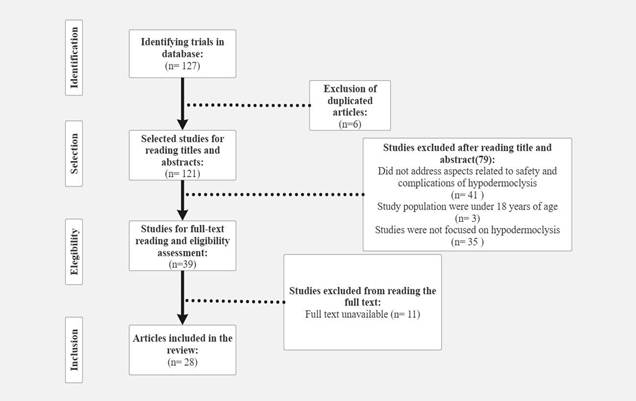
During the database search, 127 articles were identified: 25 in LILACS, 6 in SciELO, and 96 in PubMed. After this process, the studies were imported into the Rayyan application to assist in excluding duplicate studies and selecting the sample. This resulted in the exclusion of 6 duplicate articles, corresponding to 4.7% of the total, leaving 121 (95.2%) articles that were evaluated based on their titles and abstracts using the Rayyan application to verify if they answered the guiding research question.
Of the 121 articles selected for title and abstract reading, 79 were excluded for not addressing the objective of this research, which corresponds to 62.2% of the initial sample. Of the excluded manuscripts, 41 (32.2%) did not address aspects related to the safety and complications of hypodermoclysis. Three (2.3%) articles analyzed palliative care patients under eighteen years of age, who are not studied in this review. In addition, 35 (27.5%) studies were excluded because they did not focus on hypodermoclysis.
Thus, 39 manuscripts were selected for full-text reading; however, 6 (4.7%) of them only had an abstract available for free access and were therefore excluded from the sample. Therefore, 33 (25.9%) articles met the eligibility criteria and comprised the final sample of this review, as can be seen in the flowchart in Figure 1.
Figure 1 - Flowchart of the distribution of the number of articles identified, excluded, and included. Barbalha, Ceará, Brazil, 2025.
Source: Adapted from PRISMA-ScR.
Table 2 - Studies included in the scoping review, according to title, journal, study type, and country of origin. Barbalha, Ceará, Brazil, 2025.
|
N |
Article title |
Periodical and Language |
Type of Study |
Year of Publication |
Country of Origin |
|
E1 |
Adverse events of hypodermoclysis in cancer patients under palliative care: a scoping review |
Care is Fundamental Research Journal Portuguese and English. |
Scope review |
2024 |
Brazil |
|
E2 |
Factors Associated With the Occurrence of Adverse Effects Resulting From Hypodermoclysis in Older Adults in Palliative Care: A Cohort Study |
Journal of Infusion Nursing Inglês |
Cohort study |
2023 |
Brazil |
|
E3 |
Incidence and adverse events of hypodermoclysis in elderly patients receiving palliative care. |
Nursing Journal of the Central-West Region of Minas Gerais Portuguese |
This is a prospective longitudinal study with a quantitative approach. |
2023 |
Brazil |
|
E4 |
Cancer patients under palliative care: occurrences related to venipuncture and hypodermoclysis. |
Latin American Journal of Nursing Portuguese, English and Spanish |
Observational, descriptive, and multicenter study. |
2022 |
Brazil |
|
E5 |
Cancer patients in Palliative Care: occurrences related to venipuncture and hypodermoclysis |
Latin American Journal of Nursing Portuguese, English and Spanish |
Observational, descriptive, and multicenter study. |
2022 |
Brazil |
|
E6 |
Evaluation of efficacy and safety of subcutaneous acetaminophen in geriatrics and palliative care (APAPSUBQ) |
BMC Palliative Care Inglês |
Clinical trial |
2022 |
Lebanon |
|
E7 |
Effectiveness and Safety of Hypodermoclysis Patients With Cancer: A Single-Center Experience From Saudi Arabia |
Cureus: Journal of Medical Science Inglês |
Observational study |
2021 |
Saudi Arabia |
|
E8 |
Complications related to peripheral venous puncture and hypodermoclysis in cancer patients under palliative care. |
Nursing Journal of UFSM Portuguese |
Descriptive and longitudinal study |
2021 |
Brazil |
|
E9 |
Hypodermoclysis as a Strategy for Patients With End-of-life Cancer in Home Care Settings |
American Journal of Hospice and Palliative Medicine Inglês |
Retrospective study |
2020 |
Brazil |
|
E10 |
Subcutaneous hydration and medications infusions (effectiveness, safety, acceptability): A systematic review of systematic reviews. |
Plos One Journal Inglês |
Systematic review |
2020 |
United States of America |
|
E11 |
Subcutaneous Versus Intravenous Rehydration in Hospitalized Older Adults: A Meta-Analysis |
Journal of Infusion Nursing Inglês |
Systematic review |
2020 |
United States of America |
|
E12 |
Complications of the subcutaneous route in the infusion of medications and solutions in palliative care. |
Journal of the Northeast Nursing Network Portuguese |
Observational, prospective study |
2019 |
Brazil |
|
E13 |
Hypodermoclysis in cancer patients in palliative care. |
Nursing Journal of UFSM Portuguese |
Descriptive cross-sectional study |
2018 |
Brazil |
|
E14 |
Subcutaneous Infusion of Fluids for Hydration or Nutrition: A Review |
Journal of Parenteral and Enteral Nutrition Inglês |
Literature review |
2018 |
United States of America |
|
E15 |
Benefits of hypodermoclysis in the palliative care of cancer patients: a case report. |
Brazilian Journal of Cancerology Portuguese |
Case report |
2017 |
Brazil |
|
E16 |
Adverse effects of hypodermoclysis in adult patients: an integrative review. |
Brazilian Journal of Nursing Portuguese and English |
Integrative review |
2016 |
Brazil |
|
E17 |
Hypodermoclysis in cancer patients under palliative care. |
Consider Nursing Portuguese |
Descriptive, quantitative, and prospective study. |
2013 |
Brazil |
|
E18 |
Subcutaneous route: a second option in palliative care. |
HCPA Magazine Portuguese |
Theoretical review |
2012 |
Brazil |
|
E19 |
Hypodermoclisis in patients with terminal cancer |
Cuban Journal of Medicine Spanish |
Prospective study. |
2011 |
Cuba |
|
E20 |
Use of the subcutaneous route in end-of-life care at the Naval Geriátrico Center |
Horizonte Médico Magazine Spanish l |
Descriptive study, retrospective in nature. |
2011 |
Peru |
|
E21 |
Hypodermoclysis: renewed interest in an old technique. |
The Consultant Pharmacist Inglês |
Narrative review |
2010 |
United States of America |
|
E22 |
Continuous subcutaneous delivery of medications for home care palliative patients-using an infusion set or a pump? |
Supportive Care in Cancer Inglês |
Double-blind crossover trial |
2009 |
Israel |
|
E23 |
Hypodermoclysis in the Home and Long-term Care Settings |
Journal of Infusion Nursing Inglês |
Narrative review |
2009 |
United States of America |
|
E24 |
The subcutaneous route is an option for terminally ill patients when the oral route is lost |
Nursing magazine of the Mexican Social Security Institute Spanish |
Narrative review |
2009 |
Mexico |
|
E25 |
Subcutaneous therapy in advanced cancer |
Brazilian Ministry of Health Portuguese |
Protocol |
2009 |
Brazil |
|
E26 |
Initial Experiences with Subcutaneous Recombinant Human Hyaluronidase |
Journal of Palliative Medicine Inglês |
Retrospective review |
2007 |
United States of America |
|
E27 |
Hypodermoclysis: an alternative infusion technique. |
American Family Physician Inglês |
Narrative review |
2001 |
Israel |
|
E28 |
A randomized controlled trial of local injections of hyaluronidase versus placebo in cancer patients receiving subcutaneous hydration |
Annals of Oncology Inglês |
Double-blind crossover trial |
1999 |
Netherland |
|
E29 |
Subcutaneous fluid administration- better than the intravenous approach? |
Journal of Hospital Infection Inglês |
Narrative review |
1999 |
UK |
|
E30 |
Volume of hydration in terminal cancer patients. |
Support Care Cancer Inglês |
Retrospective study |
1996 |
Canada |
|
E31 |
Comparison of Two Different Concentrations of Hyaluronidase in Patients Receiving One-Hour Infusions of Hypodermoclysis |
Journal of Pain and Symptom Management Inglês |
Double-blind, cross-referenced prospective trial |
1995 |
Canadá |
|
E32 |
The Use of Hypodermoclysis for Rehydration in Terminally ill Cancer Patients |
Journal of Pain and Symptom Management Inglês |
Open prospective study |
1994 |
United States of America |
|
E33 |
Hypodermoclysis for Symptom Control in Terminal Care |
Canadian Family Physician Inglês |
Narrative review |
1985 |
Canada |
Source: Authors, 2025.
The scope of scientific evidence on the safety aspects and complications related to the use of hypodermoclysis in palliative care was grouped into the following categories: Main uses of hypodermoclysis and its limitations; Complications reported in subcutaneous administration; Puncture sites and hypodermoclysis administration techniques most associated with adverse effects; Safety aspects of hypodermoclysis compared to other routes of fluid and medication administration; and Benefits of using hypodermoclysis in palliative care. A synthesis of the scientific production on this topic is presented in Table 3.
Table 3 - Categories related to evidence on the safety aspects and complications of hypodermoclysis in palliative care. Barbalha, Ceará, Brazil, 2025.
|
Main uses of hypodermoclysis and its limitations. |
|
|
The subcutaneous route is used for the administration of medications, mainly analgesics, corticosteroids, and antiemetics, and for patient hydration (5); Its limitations include restrictions on certain medications and the infeasibility of infusing large volumes (15); Water-soluble drugs are the most compatible with the subcutaneous route, due to the lower risk of cumulative effects (16); The main drugs used subcutaneously in palliative care are: ketamine, dexamethasone, scopolamine, haloperidol, furosemide, metoclopramide, midazolam, morphine, ranitidine, ondansetron, and octreotide (17); Diazepam, phenytoin, and chlorpromazine are contraindicated for subcutaneous use due to the risk of tissue necrosis (17). |
|
|
Complications reported with subcutaneous administration |
|
|
Most common complications (4,7,18,19) |
Rare complications (7, 16,17,20) |
|
Erythema Local edema Catheter obstruction Local pain Ecchymosis Hematoma Abscess Local itching |
Heart failure Intestinal perforation Pulmonary edema Circulatory shock Tissue necrosis Burning sensation Fluid overload Changes in plasma and electrolyte concentrations Drug eruption Granuloma |
|
Puncture sites and hypodermoclysis administration techniques most associated with adverse effects. |
|
|
The most common puncture sites are the scapular, pectoral, and lower abdominal regions (21); A study analyzed 254 subcutaneous punctures and, of the reported complications, edema and hyperemia were the main causes of these adverse effects. The puncture site most associated with these adverse effects was the deltoid region (22) ; Studies show the use of hyaluronidase to improve absorption via the subcutaneous route. However, edema and local irritation are associated adverse effects that may occur with its administration (20,21,23,24,25); The use of recombinant human hyaluronidase allows for an increased infusion rate via the subcutaneous route without causing swelling or local discomfort, according to an American study (26); Decreasing the infusion rate reduces the risk of edema; Complications related to drug eruption, granuloma, infiltration, cellulitis, and bleeding were rare occurrences (17); A study showed reports of shock after infusion of hypotonic and hypertonic solutions, changes in electrolyte concentration, and side effects of hyaluronidase (7); Rotating the infusion site every 3-6 days on average and decreasing the infusion rate reduced edema and local discomfort in the study population (27); Solutions with extreme pH (< 2 or > 11) present a higher risk of adverse effects due to precipitation or local irritation(19,28); The combination of drugs from the same group, or antagonists, or drugs that precipitate, or contraindicated drugs, such as Chlorpromazine, Diazepam, and Metamizole, increases the risk of complications(18); Infections at the site can be minimized with proper skin preparation and wound dressing, in addition to changing the infusion site every 24 hours(2). |
|
|
Safety aspects of hypodermoclysis compared to other routes of fluid and drug administration. |
|
|
A study compared Deep Venous Puncture (DVP) and hypodermoclysis. Patients who used DVP presented adverse effects such as local pain, extravasation, kinked catheter, and pulled catheter, while there were no complications related to the use of hypodermoclysis (29); Medications administered subcutaneously and intramuscularly have similar pharmacokinetics. However, the duration of action is longer with the subcutaneous route (28); A comparison between peripheral venous puncture and hypodermoclysis in oncology patients admitted to a palliative care unit showed that the occurrence of adverse effects related to hypodermoclysis was milder, with reports of signs of inflammation and hematoma at the subcutaneous puncture site in the vast majority of cases. Intravenous punctures presented more serious complications, ranging from local pain to occlusion (obstructed catheter), phlebitis, among other complications(5); The subcutaneous route, when compared with epidural and intravenous routes for various opioids, proved to be equivalent in efficacy, safety, and acceptability(6); Regarding hydration, the subcutaneous and intravenous routes proved to be equally effective, with fluid absorption by hypodermoclysis being considered complete and comparable to intravenous fluid absorption(30). |
|
|
Benefits of using hypodermoclysis in Palliative Care |
|
|
Minimal painful discomfort(15); The infusion can be interrupted after it has started and at any time, without the risk of complications such as, for example, vessel thrombosis(28); Risk of systemic complications, such as hyperhydration and cardiac overload, can be monitored throughout the infusion(28); Allows the combination of several drugs with each other(18); This method can be used in home care, which reduces the need for hospitalization(31). |
|
Source: Authors, 2025.
DISCUSSION
The analysis of the results of this review shows that hypodermoclysis is a safe and effective alternative for patients in palliative care, especially for those who do not tolerate oral medication administration (17). Studies highlight the ease of application and the possibility of use at different anatomical points, making it suitable for home environments, providing greater patient comfort (9,32). These characteristics make hypodermoclysis an essential choice in palliative care, where comfort and practicality are priorities.
Regarding the main uses of the technique, most studies highlight the use of hypodermoclysis in the hydration of patients in palliative care, demonstrating numerous benefits when administered in small volumes (9,29). When compared to the intravenous route, it presents similar efficacy in the treatment of mild dehydration, with a lower risk of complications such as phlebitis. Furthermore, it is a safe and effective option for administering medications tolerated by this route in patients who present symptoms such as nausea, vomiting, and swallowing difficulties, thus representing an alternative to the oral route (15).
However, the limited number of medications that can be safely administered subcutaneously is noteworthy. The drugs most commonly administered via hypodermoclysis include analgesics, especially opioids, with morphine being the main representative. In addition, corticosteroids such as dexamethasone and antiemetics such as metoclopramide and ondansetron are also used (4,9). On the other hand, medications such as diazepam, phenytoin, and chlorpromazine are contraindicated due to the risk of tissue necrosis (16).
Regarding the main limitations of the technique observed in studies, the restriction on the use of large volumes is highlighted, since high-rate infusions are associated with a higher incidence of adverse events. In this sense, an infusion rate of approximately 50 mL/h is recommended for the treatment of dehydration in order to minimize the risk of complications(6). This limits its application to cases of severe dehydration or in emergency situations(20). Another factor is the impossibility of using certain medications due to the risk of necrosis, caused by extreme pH, osmolarity and solubility characteristics of some formulations(16).
Regarding the most common complications, the analyzed evidence includes mild edema, erythema, local pain, extravasation, bleeding and hematomas, all easily preventable and resolved(15,17). It is important to emphasize that complications related to hypodermoclysis tend to be less severe, with reports of signs of inflammation and hematoma at the subcutaneous puncture site. In contrast, occurrences associated with the intravenous route tend to be more severe, demonstrating that hypodermoclysis is a less invasive and more tolerable technique for these patients(27,29,33). Regarding complications attributed to the subcutaneous route, serious events are described in few scientific studies, and are frequently related to the technique used and the patient's health condition. In this sense, inadequate catheter selection or insertion can cause perforation of organs located below the infusion site. The use of drugs incompatible with this method, such as diazepam, phenytoin, and chlorpromazine, can lead to tissue necrosis.
Additionally, studies have also observed that large-volume infusion can cause fluid overload, resulting in pulmonary edema and heart failure, mainly in patients with comorbidities such as renal or cardiac insufficiency (17). Furthermore, the administration of large amounts of fluids without due care increases the risk of alterations in the body's hydroelectrolytic concentration. Therefore, professional training and assessment of the patient's clinical conditions can minimize the risks of serious complications.
Regarding injection sites, evidence shows that they are similar to those used for insulin, and preferred regions may vary depending on clinical criteria. In outpatient and home settings, the upper chest, abdomen, anterolateral thigh, arms, and scapular area are the most commonly used sites. However, researchers warn about the importance of avoiding damaged or edematous skin areas, areas undergoing radiotherapy, or areas in the healing process, as these increase the chance of adverse effects(17). They also highlight the deltoid region as the site most associated with complications, mainly edema and hyperemia (22).
The scientific literature reveals variations in the way hypodermoclysis is used, reinforcing the importance of adopting good practices to reduce the occurrence of complications. In this context, aseptic precautions, and the choice and rotation of the injection site are measures associated with a lower incidence of infections, as described in the studies. Other measures mentioned are controlling the infusion rate and volume to avoid localized or systemic edema. In addition to being attentive to medications and the patient's clinical conditions that may contraindicate the choice of hypodermoclysis as a route of administration, in order to avoid more serious complications(17).
Another aspect addressed is related to the use of hyaluronidase, a mucolytic enzyme that reduces the interstitial viscosity of connective tissue, which increases the absorption and diffusion of fluids in hypodermoclysis. The amount of enzyme usually administered is 150 U/ml per liter of fluid. It is used to facilitate the administration of large volumes at a high infusion rate, as well as to reduce edema and local pain. However, studies have observed that hyaluronidase can cause hypersensitivity reactions, and a sensitivity test is recommended which, if positive, contraindicates the application of the drug(20).
Furthermore, a study produced by Caccialanza et al. (2) states that adding hyaluronidase to routine hypodermoclysis increases the complexity, risk of allergies, and cost of the procedure in a context where the benefit of using the enzyme is unclear beyond high-rate fluid infusion. In this sense, in general, studies present positive points regarding the use of the enzyme; however, they reinforce that it should be done with caution and that more studies are needed on this topic.
Regarding the safety profile, hypodermoclysis proved superior compared to other routes of fluid and medication administration. Brazilian studies developed by Lago et al. (29) and Bolela et al. (3) investigated the main occurrences related to venous puncture and the subcutaneous route and observed that there were few records of adverse effects associated with the subcutaneous route, with most cases related to hyperemia and edema at the puncture site.
When analyzing the intravenous route of administration, scientific evidence shows that complications were more frequent and often more severe, with reports ranging from blood staining at the catheter insertion site, catheter obstruction, local pain, to varying degrees of phlebitis. However, because it is still a relatively unknown technique, hypodermoclysis is often overlooked in favor of other more established methods in healthcare services, such as the intravenous route.
When compared in terms of efficacy, the subcutaneous route proved similar to other infusion routes observed in the studies, such as intramuscular and intravenous. The systematic review by Broadhurst et al.(6) analyzed the subcutaneous administration of the main analgesics used in palliative care and found strong evidence for the use of morphine, which showed comparable efficacy to intravenous administration, with fewer side effects.
In addition, there is consensus among the analyzed articles that subcutaneous hydration proved to be effective and safe, potentially presenting fewer adverse effects, greater ease of use, and lower costs when compared to intravenous administration. However, not all cancer patients in palliative care benefit from vigorous hydration, whether by hypodermoclysis or intravenously, as studies question the effectiveness of hydration for symptom control and improvement of quality of life in end-of-life patients with advanced cancer(33).
Regarding the benefits of hypodermoclysis in palliative care, studies mainly highlight better patient acceptability, justified by the lower occurrence of complications associated with this technique. This can be evidenced in the work of Broadhurst et al.(6), who observed that catheter extraction and agitation associated with the device were less in hypodermoclysis, which explains the greater tolerability to subcutaneous infusion, reinforcing better patient adherence to the method.
Furthermore, regarding the benefits of the subcutaneous route, the studies included in this review mention the possibility of its use at home, which provides greater comfort for the patient and contributes to reducing hospitalization time. In fact, the convenience of being able to administer it at home is advantageous, especially for pain control in patients with advanced cancer, where this symptom is effectively present, being one of the main factors responsible for prolonging hospital stays and, consequently, negatively impacting the patient's quality of life (31,34).
The knowledge gaps identified in this review relate primarily to the predominance of studies conducted in a national context, which may restrict the generalization of results to other realities, considering the cultural, demographic, and structural differences in health systems across different countries. Furthermore, the absence of clinical trials with robust methodological design and the scarcity of recent research on the topic constitute limitations that may have impacted both the breadth of the sample and the consistency of the analysis of the findings.
One of the limitations of this scoping review is the reduced number of studies on the use of hypodermoclysis in adult cancer patients in palliative care, especially primary studies on the subject, which may be justified by a lack of awareness and, consequently, limited use of the technique by healthcare professionals. The methodological diversity of the analyzed articles is also noteworthy, limiting the possibility of comparing the results.
Therefore, this review has the potential to contribute to the discussion of a topic relevant to public health, by synthesizing the main scientific evidence on the safety aspects and complications related to the use of hypodermoclysis in palliative care. With this, the authors seek to foster the development of new studies in the area, with the aim of enabling the creation of protocols to guide the safe use of the technique, the dissemination of knowledge about hypodermoclysis, and thus, assisting in the improvement of healthcare.
CONCLUSION
Available studies suggest that hypodermoclysis is an effective technique for administering fluids and medications with minimal complications in the context of palliative care. In this sense, the most common adverse effects are of low intensity, easily prevented and resolved. Regarding rare complications, they can be serious, but care with the application technique, medications, and the patient's clinical condition can significantly reduce their occurrence.
Furthermore, the subcutaneous route is considered safer when compared to other forms of medication administration. The scientific literature indicates that the occurrence of adverse effects is infrequent and, in most cases, mild. In contrast, the intravenous route is more complex, with more frequent, generally more serious complications, and more prone to technical errors.
Therefore, mapping the available evidence on hypodermoclysis in palliative care showed that the method is effective, safe, low-cost, easy to apply, and can be performed in a home setting, making it an interesting alternative when the oral route is unavailable for patients in palliative care. However, it is important to highlight that the methodological heterogeneity of the studies included in this review and the predominance of national studies are factors that influence the interpretation of the results.
In light of the above, it is recommended that additional studies be conducted, with a high level of scientific evidence, to support the development of clinical protocols aimed at the safe and effective use of hypodermoclysis in palliative care. Such investigations could significantly contribute to improving professional training and the quality of care provided to patients in palliative care, reinforcing its relevance to public health.
REFERENCES
1 Worldwide Hospice Palliative Care Alliance. Global Atlas of Palliative Care [Internet]. 2nd ed. London; 2020 [citado 2024 Out 28]. Disponível em: https://thewhpca.org/track-download/?action=increment_download_count&post_id=1465
2 Caccialanza R, Lirosi MC, Mazzola V, Rezzani C, Cereda E. Subcutaneous infusion of fluids for hydration or nutrition: a review. J Parenter Enteral Nutr. 2018;42(2):296–307.
3 Bolela F, Lago AJO, Souza AC. Pacientes oncológicos sob cuidados paliativos: ocorrências relacionadas à punção venosa e hipodermóclise. Rev Lat Am Enfermagem. 2022;30:e3623.
4 Coelho TA, Wainstein AJA, Drummond-Lage AP. Hypodermoclysis as a strategy for patients with end-of-life cancer in home care settings. Am J Hosp Palliat Care. 2020;37(9):675–82.
5 Fortuna CM. O uso da via subcutânea em geriatria e cuidados paliativos: um guia da SBGG e da ANCP para profissionais [Internet]. 2nd ed. [Place unknown]: SBGG; 2017 [citado 2025 Abr 10]. Disponível em: https://sbgg.org.br//wp-content/uploads/2017/11/SBGG_guia-subcutanea_2aedicao.pdf
6 Broadhurst D, Jones M, Jones R, Portlock J. Subcutaneous hydration and medications infusions (effectiveness, safety, acceptability): A systematic review of systematic reviews. PLoS One. 2020 Aug 24;15(8):e0237572.
7 Nunes PMSA, Souza RCS. Efeitos adversos da hipodermóclise em pacientes adultos: revisão integrativa. REME Rev Min Enferm. 2016;20(1). Doi: https://doi.org/10.5935/1415-2762.20160020
8 Danielsen MB, Thomsen T, Færgeman K, Petersen J, Nielson LP, Bilenberg T. Harms and benefits of subcutaneous hydration in older patients: systematic review and meta-analysis. J Am Geriatr Soc. 2020;68(12):2937–46.
9 Ferraciolli CJ, Bolela F, Guimarães R, Lago AJO, Souza AC. Eventos adversos da hipodermóclise em pacientes oncológicos sob cuidados paliativos: revisão de escopo. Rev Pesqui Cuid Fundam. 2024;16:e13209–e13209.
10 Aromataris E, Lockwood C, Porritt K, Pilla B, Jordan Z, editors. JBI manual for evidence synthesis [Internet]. Adelaide: JBI; 2024 [citado 2025 Abr 13]. Disponível em: https://synthesismanual.jbi.global.
11 Tricco AC, Lillie E, Zarin W, O’Brien KK, Colquhoun H, Levac D, et al. PRISMA extension for scoping reviews (PRISMA-ScR): checklist and explanation. Ann Intern Med. 2018;169(7):467–73.
12 Brasil. Ministério da Saúde. Secretaria de Ciência, Tecnologia e Insumos Estratégicos. Diretrizes metodológicas. 1st ed. Brasília: Ministério da Saúde; 2021 [citado 2025 Abr 13]. Disponível em: https://rebrats.saude.gov.br/images/Documentos/2021/20210622_Diretriz_Revisao_Sistematica_2021.pdf
13 Whittemore R, Knafl K. The integrative review: updated methodology. J Adv Nurs. 2005;52(5):546–53.
14 Brasil. Casa Civil. Lei nº 12.853, de 14 de agosto de 2013. Altera, atualiza e consolida a legislação sobre direitos autorais e dá outras providências. Diário Oficial da União, Brasília, DF, Brasil, 2013 Aug 15;Seção 1:1.
15 Justino E, Souza AC, Lago AJO. Hipodermóclise em pacientes oncológicos sob cuidados paliativos. Cogitare Enferm. 2013;18(1):84–9.
16 Pontalti G, Cogo SB, Badke MR, Guedes NAB. Hipodermóclise em pacientes com câncer em cuidados paliativos. Rev Enferm UFSM. 2018;8(2):276.
17 Pontalti G, Cogo SB, Badke MR, Guedes NAB. Via subcutânea: segunda opção em cuidados paliativos [Internet]. Clin Biomed Res. 2012 Jul 20;32(2) [citado 2025 Abr 10]. Disponível em: https://seer.ufrgs.br/index.php/hcpa/article/view/26270
18 Bautista-Eugenio V, Salinas-Cruz J. La vía subcutánea opción para el paciente terminal cuando se pierde la vía oral. Rev Enferm Inst Mex Seguro Soc. 2009;17(3):149–52.
19 De Souza RE, Ferraciolli CJ, Bolela F, Souza AC. Incidência e eventos adversos da hipodermóclise no idoso em cuidados paliativos. Rev Enferm Cent-Oeste Min. 2023;13:e4905.
20 Lybarger EH. Hypodermoclysis in the home and long-term care settings. J Infus Nurs. 2009;32(1):40–4.
21 Jain S, Mansfield B, Wilcox MH. Subcutaneous fluid administration–better than the intravenous approach? J Hosp Infect. 1999;41(4):269–72.
22 Guedes NAB, Cogo SB, Badke MR, Pontalti G. Complicações da via subcutânea na infusão de medicamentos e soluções em cuidados paliativos. Rev Rene. 2019;20:e40241.
23 Hayes H. Hypodermoclysis for symptom control in terminal care. Can Fam Physician. 1985;31:1253–7.
24 Fainsinger RL, MacEachern T, Hanson J, Bruera E. The use of hypodermoclysis for rehydration in terminally ill cancer patients. J Pain Symptom Manage. 1994;9(5):298–302.
25 Bruera E, De Stoutz N, Velasco-Leiva A, Schoeller T, Hanson J. A randomized controlled trial of local injections of hyaluronidase versus placebo in cancer patients receiving subcutaneous hydration. Ann Oncol. 1999;10(10):1255–8.
26 Pirrello RD, Ting Chen C, Thomas SH. Initial experiences with subcutaneous recombinant human hyaluronidase. J Palliat Med. 2007;10(4):861–4.
27 Perera AH, Hall Smith C, Perera AH. Hipodermoclisis en pacientes con cáncer terminal. Rev Cubana Med. 2011;50(2):150–6.
28 Instituto Nacional do Câncer. Terapia subcutânea no câncer avançado: Série Cuidados Paliativos [Internet]. Rio de Janeiro: INCA; 2009 [citado 2024 Out 28]. Disponível em: https://bvsms.saude.gov.br/bvs/publicacoes/inca/Terapia_subcutanea.pdf
29 Lago AJO, Souza AC, Bolela F. Complicações relacionadas à punção venosa periférica e à hipodermóclise em pacientes oncológicos sob cuidados paliativos. Rev Enferm UFSM. 2021;11:e76.
30 Martin CM. Hypodermoclysis: renewed interest in an old technique. Consult Pharm. 2010;25(4):204–12.
31 Sasson M, Shvartzman P. Hypodermoclysis: an alternative infusion technique. Am Fam Physician. 2001;64(9):1575–9.
32 Pontalti G, Cogo SB, Badke MR, Guedes NAB. Benefícios da hipodermóclise na clínica paliativa de pacientes com câncer: relato de caso. Rev Bras Cancerol. 2016;62(3):247–52.
33 Bruera E, Hui D, Elsayem A, Baron M, Fukui S, Agustin Y, et al. Parenteral hydration in patients with advanced cancer: a multicenter, double-blind, placebo-controlled randomized trial. J Clin Oncol. 2013;31(1):111–8.
34 Sampaio SGSM, da Motta LB, Caldas CP. Dor e internação hospitalar em cuidados paliativos. Rev Bras Cancerol. 2021;67(3):e202131.
Funding and Acknowledgments:
This research received no funding.
Authorship Criteria (Authors' Contributions)
1. Contributed substantially to the conception and/or planning of the study: Lucileide SS, Marcos LM, Lara LL, Vitória CFR, Ana Maria PGA, Sandra BFS;
2. Contributed to the acquisition, analysis, and/or interpretation of the data: Lucileide SS, Marcos LM, Lara LL, Vitória CFR, Ana Maria PGA, Sandra BFS;
3. Contributed to the writing and/or critical review and final approval of the published version: Lucileide SS, Marcos LM, Lara LL, Vitória CFR, Ana Maria PGA, Sandra BFS.
Conflict of Interest Statement
Nothing to declare
Scientific Editor: Ítalo Arão Pereira Ribeiro. Orcid: https://orcid.org/0000-0003-0778-1447
Rev Enferm Atual In Derme 2026;100(1): e026004
 Atribuição
CCBY
Atribuição
CCBY