REVIEW ARTICLE
NON-PHARMACOLOGICAL METHODS FOR PAIN RELIEF DURING LABOR
MÉTODOS NO FARMACOLÓGICOS PARA ALIVIAR EL DOLOR DURANTE EL PARTO
MÉTODOS NÃO FARMACOLÓGICOS PARA O ALÍVIO DA DOR DURANTE O TRABALHO DE PARTO
https://doi.org/10.31011/reaid-2026-v.100-n.1-art.2613
1Marilia Miranda Pereira
2Yasmim Caroline de Araújo Silva
3Arilane Salino Dias
4Elliza Emily Perrone Barbosa
1Centro Universitário FAMETRO, Manaus – AM, Brazil - Orcid: https://orcid.org/0000-0002-2091-5449
2Centro Universitário FAMETRO, Manaus – AM, Brazil - Orcid: https://orcid.org/0000-0002-4578-9012
3Centro Universitário FAMETRO, Manaus – AM, Brazil - Orcid: https://orcid.org/0000-0002-5824-4433
4Centro Universitário FAMETRO, Manaus – AM, Brazil - Orcid: https://orcid.org/0000-0003-2832-2629
Corresponding Author
Marilia Miranda Pereira
Rua: Tutankamon casa 79 - Manaus – AM - Brazil - Cep: 69095-525 – contact +55(92) 99466-6045 – E-mail: Mariliamiranda1987@gmail.com
Submission: 19-07-2025
Approval: 18-11-2025
ABSTRACT
Labor pain is a multifactorial phenomenon involving physical, emotional, and social aspects, and is considered one of the most intense experiences in a woman's life. Objective: To analyze the scientific literature on non-pharmacological methods used for pain relief during labor, identifying the main practices employed and their effects on pain experience and maternal well-being. Methods: Integrative Literature Review conducted in six methodological steps. The PRISMA protocol was followed for article selection, and the PICo strategy was used to formulate the guiding question. Descriptors from DeCS and MeSH were combined using the Boolean operator AND: labor pain, labor, obstetric, pregnant women, complementary therapies, obstetric nursing. The search was conducted in the LILACS, Web of Science, MEDLINE, and SciELO databases, focusing on publications from the last six years. The final sample included 12 articles. Results: The most used non-pharmacological methods were floral therapy, hydrotherapy, birthing ball, ambulation, sacral massage, auriculotherapy, and ice massage at the SP6 point. Studies demonstrated effectiveness in reducing pain, anxiety, and labor duration, while promoting physical and emotional comfort. Positive maternal perceptions and the emphasis on women's protagonism were recurrent findings. Final considerations: This study aims to support the expansion of integrative practices in obstetric care, fostering more humanized, respectful, and woman-centered assistance, and guiding actions to strengthen professional training and public policies for childbirth humanization.
Keywords: Pain During Childbirth; Pregnant Women; Complementary Therapies; Nursing; Obstetrics.
RESUMEN
El dolor del parto es un fenómeno multifactorial que involucra aspectos físicos, emocionales y sociales, y se considera una de las experiencias más intensas en la vida de la mujer. Objetivo: Analizar la producción científica sobre los métodos no farmacológicos utilizados para aliviar el dolor durante el trabajo de parto, identificando las principales prácticas empleadas y sus efectos en la experiencia del dolor y el bienestar de las gestantes. Métodos: Revisión Integrativa de la Literatura, realizada en seis etapas metodológicas. Se siguió el protocolo PRISMA para la selección de artículos y la estrategia PICo para la construcción de la pregunta orientadora. Se utilizaron los descriptores DeCS y MeSH, combinados con el operador booleano AND: dolor de parto, trabajo de parto, personas embarazadas, terapias complementarias, enfermería obstétrica. La búsqueda se realizó en las bases LILACS, Web of Science, MEDLINE y SciELO, con publicaciones de los últimos seis años. La muestra final incluyó 12 artículos. Resultados: Los métodos no farmacológicos más utilizados fueron la terapia floral, la hidroterapia, la pelota de parto, la deambulación, el masaje sacro, la auriculoterapia y el masaje con hielo en el punto SP6. Los estudios demostraron eficacia en la reducción del dolor, la ansiedad y la duración del parto, además de promover el confort físico y emocional. La percepción positiva de las mujeres y la valorización del protagonismo femenino fueron hallazgos recurrentes. Consideraciones finales: Se espera que este estudio contribuya a ampliar el uso de prácticas integrativas en la atención obstétrica, promoviendo un cuidado más humanizado, respetuoso y centrado en la mujer, además de orientar acciones que fortalezcan la capacitación profesional y las políticas públicas para la humanización del parto.
Palabras clave: Dolor del Parto; Mujeres Embarazadas; Terapias Complementarias; Enfermería; Obstetricia.
RESUMO
A dor do parto é um fenômeno multifatorial que envolve aspectos físicos, emocionais e sociais, sendo considerada uma das experiências mais intensas na vida da mulher. Objetivo: Analisar a produção científica sobre os métodos não farmacológicos utilizados para o alívio da dor durante o trabalho de parto, identificando as principais práticas empregadas e seus efeitos na experiência da dor e no bem-estar das gestantes. Métodos: Revisão Integrativa da Literatura, conduzida em seis etapas metodológicas. Seguiu-se o protocolo PRISMA para seleção dos artigos e a estratégia PICo para construção da pergunta norteadora. Utilizaram-se os descritores DeCS e MeSH, cruzados com o operador booleano AND, sendo: Dor do parto, trabalho de parto, gestantes, terapias complementares, enfermagem obstétrica/Labor pain, labor, obstetric, pregnant women, complementary therapies, obstetric nursing. A busca foi realizada nas bases LILACS, Web of Science, MEDLINE e SciELO, com publicações dos últimos seis anos. A amostra final foi composta por 12 artigos. Resultados: Os métodos não farmacológicos mais utilizados foram terapia floral, hidroterapia, bola suíça, deambulação, massagem sacral, auriculoterapia e massagem com gelo no ponto SP6. Os estudos demonstraram eficácia na redução da dor, ansiedade e tempo de parto, além de promoverem conforto físico e emocional. A percepção positiva das mulheres e a valorização do protagonismo feminino foram aspectos recorrentes. Considerações finais: Espera-se que esta pesquisa contribua para a ampliação do uso de práticas integrativas na assistência obstétrica, promovendo um cuidado mais humanizado, respeitoso e centrado na mulher, além de subsidiar ações que fortaleçam a capacitação profissional e a implementação de políticas públicas voltadas à humanização do parto.
Palavras-chave: Dor do Parto; Gestantes; Terapias Complementares; Enfermagem; Obstetrícia.
INTRODUCTION
Labor is a complex biological and psychosocial phenomenon that represents the final stage of gestation, during which intense physiological changes occur to enable birth(1). This process is accompanied by a series of emotional and physical reactions that make the experience unique for each woman. The onset of uterine contractions, cervical dilation, and fetal descent demand effort and endurance, often accompanied by intense pain, considered one of the most significant in human experience(2).
The pain felt during childbirth is multifactorial, influenced by aspects such as individual sensitivity, the duration of labor, the care environment, and the level of emotional support available(3). More than a physical symptom, pain is intertwined with the woman's psychological sphere and can be intensified by feelings of fear, insecurity, or lack of preparedness. Thus, pain management is an essential condition to ensure a birth with less suffering and better well-being for the parturient(4).
Pain, as described by the World Health Organization (WHO) and the International Association for the Study of Pain (IASP), is an unwanted sensory and emotional experience resulting from tissue damage, whether actual or merely threatened. This definition recognizes pain as a multifaceted phenomenon that goes beyond the physical dimension, including subjective aspects that vary from person to person (5).
Traditionally, pharmacological methods are widely used in obstetrics to promote pain relief, including systemic analgesia and regional anesthesia, such as epidural anesthesia (6). Although effective, these resources can have side effects, negatively influence the physiological progression of labor, and limit the woman's mobility, interfering with her autonomy during the process. For this reason, there is a growing appreciation for alternative approaches that respect the nature of the body and promote the humanization of care (2).
In this context, non-pharmacological methods have gained ground by offering safe, accessible, and woman-centered strategies (1). These practices activate natural pain relief mechanisms, such as the release of endorphins and sensory distraction, in addition to promoting physical comfort and emotional security (7).
Beyond clinical benefits, non-pharmacological methods contribute directly to building a more humanized care environment, where women's decisions are respected and their protagonism is guaranteed (8). The application of these techniques is aligned with international guidelines that recommend childbirth practices centered on natural physiology and respect for the parturient's values and choices. Therefore, their use represents an advance in the quality of obstetric care and in the promotion of more positive and healthy births (9).
Despite the growing recognition of non-pharmacological methods in obstetric care, gaps still persist in the organization and understanding of scientific knowledge related to these practices. Aspects such as the types of methods used, the approaches applied, their clinical effectiveness, applicability in different contexts, and the level of acceptance by health professionals still require further investigation (10). This scenario highlights the need to gather and systematize scientific evidence that clarifies these practices, supporting more assertive clinical conduct and expanding the offer of humanized, respectful care that is consistent with the individual needs of women in labor (11).
Given this reality, the present study aims to analyze the scientific production on non-pharmacological methods used for pain relief during labor, identifying the main practices employed and their effects on the pain experience and well-being of pregnant women.
METHODS
This research was conducted through an Integrative Literature Review (ILR), highlighting it as an essential strategy to strengthen the use of scientific knowledge applicable to professional practice in health and to boost academic development in the area. The review followed six sequential and interconnected methodological steps: definition of the theme and formulation of the central research question; delimitation of the inclusion and exclusion criteria of the studies; organization and categorization of the selected materials; critical analysis of the included texts; interpretation of the findings obtained; and, finally, the integration of the information that will compose the synthesis of the generated knowledge(12).
To ensure transparency and methodological consistency, the guidelines established by the Preferred Reporting Items for Systematic Reviews and Meta-Analyses (PRISMA) protocol were adopted(13). The study was guided by a guiding question constructed from the PICo strategy(14): What non-pharmacological methods will be used during labor to relieve pain in parturient women? The components of the PICo structure are defined as: P (Population) – women in labor; I (Intervention/Interest) – non-pharmacological methods aimed at pain relief; and Co (Context) – environments intended for childbirth assistance.
Data collection was conducted through consultation of widely recognized scientific databases in the health field. The Latin American and Caribbean Literature in Health Sciences (LILACS), Web of Science, Medical Literature Online (MEDLINE), and the Scientific Electronic Library Online (SciELO) digital library were selected for their relevance, scope, and quality in indexing scientific studies related to the proposed theme. The construction of search strategies involved the controlled vocabularies Medical Subject Headings (MeSH) and Health Sciences Descriptors (DeCS), combined with the Boolean operator AND, as detailed in Table 1 of the research.
Table 1 - Search strategies for retrieving publications. Manaus - AM, Brazil, 2025
|
Search |
Strategy |
|
LILACS |
Dor AND Saúde da Mulher AND Trabalho de Parto |
|
Web of Science |
Pain AND Labor Pain AND Women's Health |
|
MEDLINE |
Trabalho de Parto AND Dor do Parto AND Dor AND Parto Normal |
|
SciELO |
Labor Pain AND Dor |
Source: Authors' own work
The inclusion criteria were established considering research that directly addresses the guiding question, is fully available online, freely accessible, published in the last six years, and written in Portuguese, English, or Spanish. Theses, dissertations, monographs, editorials, abstracts of scientific events, and duplicate articles were excluded. The selection of articles will be presented in Table 2, containing the final composition of the studies chosen from the consulted databases.
Table 2 - Databases and number of selected articles. Manaus - AM, Brazil, 2025
|
Database |
Totality After criteria Final number % |
|||
|
LILACS |
91 |
98 |
4 |
33,3 |
|
Web of Science |
51 |
70 |
2 |
24,9 |
|
270 |
127 |
3 |
24,9 |
|
|
SciELO |
117 |
108 |
3 |
16,9 |
|
Total |
529 |
403 |
12 |
100% |
Source: Authors' own work
During the analysis phase, a summary table was constructed containing the main information extracted from the selected studies, with the aim of avoiding errors and inconsistencies in the research data. This table will include elements such as: study code, author(s), year of publication, language, objective, type of study, and main results. Respect for copyright will be ensured, as established by Law No. 9.610/1998, guaranteeing that all content used complies with current legal precepts.
RESULTS
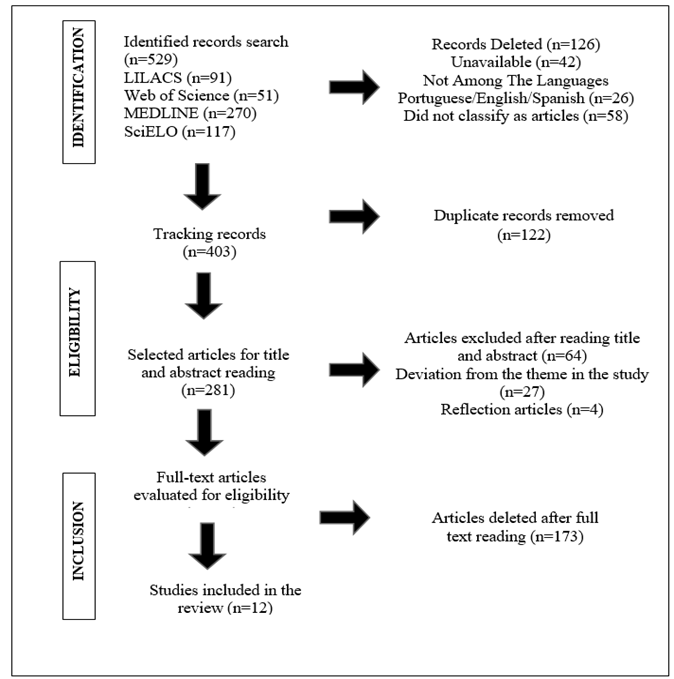
In this work, 529 studies were initially identified. After applying the previously established inclusion and exclusion criteria, this number was reduced to 403. In the next step, 185 titles and abstracts were analyzed in order to eliminate those that did not answer the guiding question. Finally, after a critical reading and in-depth interpretation of the eligible works, 12 articles were selected to compose the present study, as shown in Figure 1.
Figure 1 - Flowchart of study selection, adapted from the PRISMA recommendation. Manaus - AM, Brazil, 2025.
Source: Authors' Own Data
The year with the highest concentration of publications was 2020, with four studies, followed by 2022, with three studies. Regarding the location of the studies, Brazil stood out as the main setting for the investigations, accounting for nine of the twelve included studies. Despite this, three studies were published in English. As for the methodological design, there was a predominance of randomized clinical trials, with or without placebo control, in addition to quasi-experimental, descriptive quantitative, and exploratory qualitative studies.
The non-pharmacological practices investigated were varied, including flower therapy (present in four studies), warm baths, Swiss ball therapy, hydrotherapy, ambulation, sacral massage, auriculotherapy, use of a birthing ball, and ice massage at point SP6. Table 1 was constructed to present a synthesis of the studies included in the review.
Table 1 - Characterization of the studies analyzed in the review. Manaus-AM, Brazil, 2025.
|
N |
Authors |
Year / Language |
Title |
Type of Study |
Main Results |
Periodical |
|
1 |
Bruna Euzebio Klein e Helga Geremias Gouveia(15) |
2022 / Portuguese |
Utilização de métodos não farmacológicos para alívio da dor no trabalho de parto |
Quantitative, descriptive, cross-sectional |
29.3% of women in labor used non-lethal methods. Hydrotherapy, position changes, and breathing exercises were the most commonly used. A significant association was found with type of delivery, gestation period, and parity. Combined use showed greater comfort.
|
Cogitare Enfermagem |
|
2 |
Elaine Cristina Ribeiro Balbino et al(16) |
2020 / Portuguese |
Uso de métodos não farmacológicos no alívio da dor no trabalho de parto: a percepção de mulheres no pós-parto |
Qualitative, exploratory, cross-sectional |
70% were unaware of MNF (Mental Health and Nutrition) before delivery. 80% reported satisfaction. Nurses were the most frequently mentioned. Lack of guidance during prenatal care compromises empowerment. |
Revista Brasileira Multidisciplinar – ReBraM |
|
3 |
Jianfang Wang et al(17) |
2020 / Inglês |
The effectiveness of delivery ball use versus conventional nursing care during delivery of primiparae |
Quantitativo, comparativo, randomizado |
Menor dor, maior conforto, menor tempo de parto e hemorragia. Maior taxa de parto vaginal. Método eficaz para parto humanizado. |
Pakistan Journal of Medical Sciences |
|
4 |
Semra Akköz Çevik e Serap Karaduman(18). |
2019 / English |
The effect of sacral massage on labor pain and anxiety: A randomized controlled trial |
Experimental, randomized and controlled |
Significant reduction in pain and anxiety. Safe and effective technique. Greater satisfaction with childbirth. |
Japan Journal of Nursing Science (Wiley) |
|
5 |
Hülya Türkmen et al(19) |
2024 / English |
The Effect of Ice Massage Applied to the SP6 Point on Labor Pain, Labor Comfort, Labor Duration, and Anxiety |
Randomized, clinical, controlled, masked |
Reduced pain and increased comfort. No adverse effects. Accessible and effective technique. |
Journal of Midwifery & Women’s Health (Wiley) |
|
6 |
Sonia Regina Godinho de Lara et al(20) |
2021 / Portuguese |
Efeitos da terapia floral no trabalho de parto e nascimento: ensaio clínico randomizado |
Randomized, triple-blind clinical trial |
Pain reduction and shorter labor time. Emotional balance and coping with fear. A safe and promising technique. |
Revista Brasileira de Enfermagem – REBEn |
|
7 |
Sonia Regina Godinho de Lara et al(21) |
2022 / Portuguese |
Efetividade das essências florais no trabalho de parto e nascimento |
Randomized, placebo-controlled clinical trial |
Increased beta-endorphin levels and stable cortisol levels. Reduced labor time. Lower rate of cesarean sections due to functional dystocia. |
Acta Paulista de Enfermagem – Acta Paul Enferm |
|
8 |
Sonia Regina Godinho de Lara et al(22) |
2020 / Portuguese |
Vivência de mulheres em trabalho de parto com o uso de Essências Florais |
Qualitative, descriptive, exploratory |
Reduction of fear, tension, and stress. Women became the protagonists of childbirth. The floral group had more emotional control. |
Revista Online de Pesquisa Cuidado é Fundamental – UNIRIO |
|
9 |
Karem Cristina Mielke et al(23) |
2019 / Portuguese |
A prática de métodos não farmacológicos para o alívio da dor de parto |
Quantitative, cross-sectional, descriptive |
77.9% used non-facial medicine (NFM). Bathing and ambulation were the most well-known methods. 89.4% reported benefits. The use of multiple methods was common.
|
Avances en Enfermería – Av Enferm |
|
10 |
Patrícia de Souza Melo et al(24) |
2020 / Portuguese |
Parâmetros maternos e perinatais após intervenções não farmacológicas |
Randomized, controlled clinical trial |
A warm bath and a Swiss ball did not cause adverse effects. They increased contractions and dilation. Safe and recommended methods. |
Acta Paulista de Enfermagem – Acta Paul Enferm |
|
11 |
Reginaldo Roque Mafetoni et al(25) |
2019 / Portuguese |
Efetividade da auriculoterapia sobre a dor no trabalho de parto |
Randomized, triple-blind clinical trial |
Significant pain reduction after 60 and 120 minutes. Lower risk of perceived pain worsening. Effective and safe technique. 61.8% reported pain improvement. |
Texto & Contexto Enfermagem – UFSC |
|
12 |
Erica de Brito Pitilin et al(26) |
2022 / Portuguese |
Terapia floral na evolução do parto e na tríade dor-ansiedade-estresse: estudo quase-experimental |
Quasi-experimental, randomized, controlled |
· Significant reduction in labor time (6.7h vs. 9.4h). Increased cervical dilation and uterine contractions. Reduced cortisol in the floral therapy group. Lower cesarean section rate (RR=2.34 in the placebo group). No adverse neonatal effects. Safe, effective, and promising technique as an integrative practice.
|
Acta Paulista de Enfermagem – Acta Paul Enferm |
DISCUSSION
The discussion on non-pharmacological methods for pain relief during labor has gained prominence in the scientific literature, especially in studies that seek to promote more humanized obstetric care. Although several techniques are available, only 29.3% of women in labor used some non-pharmacological method, with hydrotherapy, position changes, and breathing exercises being the most frequent (15). This low adherence may be related to a lack of adequate guidance during prenatal care, as also pointed out in another study (16), which identified that 70% of women were unaware of these practices before delivery.
The positive perception of women who used non-pharmacological methods is a point of convergence among the studies. One study (16) highlighted that 80% of postpartum women reported satisfaction with the methods used, reinforcing the importance of the care provided by nursing professionals. This emphasis on humanized care is also observed in another study (17), which showed that the use of a birthing ball and free positions during labor resulted in less pain, greater comfort, and a higher rate of vaginal delivery, demonstrating the effectiveness of the intervention.
On the other hand, sacral massage as a pain and anxiety relief technique obtained significant results in reducing both symptoms (18). The technique proved to be safe and well-accepted by women, which corroborates another finding (19), who used ice massage on the SP6 point and observed a reduction in pain and an increase in comfort. Both techniques, although distinct, share the principle of localized sensory stimulation, which suggests that tactile interventions can be effective in pain management.
Flower therapy has been extensively investigated in several studies (20,21,26). The results point to emotional and physiological benefits, such as reduced pain, labor time, and stress, as well as increased cervical dilation and uterine contractions. However, while one study (22) emphasizes the subjective experience of women, highlighting female protagonism and emotional control, another (26) presents objective data that reinforce the effectiveness of flower therapy in the pain-anxiety-stress triad, with a significant reduction in cortisol and a lower cesarean section rate.
Despite the positive results, it is important to consider that not all studies found significant differences in all outcomes. For example, they did not observe a significant reduction in pain and anxiety between the flower and placebo groups, although they identified improvement in labor progression and stress reduction (26). This divergence may be related to the subjectivity of pain and the complexity of the emotional factors involved in labor (22).
Auriculotherapy, investigated in one study (25), showed promising results in reducing pain after 60 and 120 minutes of application, with 61.8% of women reporting improvement. This technique, based on the stimulation of auricular points, reinforces the idea that non-invasive interventions can be effective in pain management, especially when applied with technical knowledge and sensitivity to the emotional context of the parturient.
Two studies (24,27) explored the combined use of warm baths and Swiss balls, demonstrating that these practices increased cervical dilation, the frequency of contractions, and contributed to women's well-being. The studies did not identify adverse effects, which reinforces the safety of these interventions. The combination of techniques seems to potentiate the positive effects, which observed an average use of 1.93 methods per woman, with a high satisfaction rate (23).
The discussion between the studies reveals that, although different in approach and technique, they all converge on valuing women's autonomy and promoting a more natural and less medicalized childbirth. The diversity of non-pharmacological methods allows women to choose, in an informed way, the strategy that best suits their needs and preferences, provided there is adequate guidance from healthcare professionals.
However, the implementation of these practices still faces challenges, such as the lack of training for professionals, the absence of standardized protocols, and institutional resistance to the adoption of integrative approaches. Brazilian studies, in particular, point to the need to strengthen public policies aimed at humanizing childbirth and including integrative practices in the Unified Health System (SUS), as advocated by the Ministry of Health(28).
FINAL CONSIDERATIONS
Non-pharmacological methods for pain relief during labor demonstrate efficacy, safety, and wide acceptance among women, being recognized as valuable strategies in promoting a more humanized and respectful childbirth. In addition to contributing to pain and anxiety reduction, these practices promote physical and emotional comfort, strengthen the bond between the woman and healthcare professionals, and contribute to better obstetric outcomes, such as shorter labor times and fewer invasive interventions.
The literature reviewed reinforces the importance of expanding access to these practices at all levels of healthcare, especially in public services, where they are often still underutilized. To this end, it is essential to invest in the continuous training of healthcare professionals, especially obstetric nurses and physicians, so that they are able to offer these interventions with competence, sensitivity, and scientific basis.
Furthermore, it is fundamental to promote woman-centered care that respects her individuality, her desires, and her protagonism in the birthing process. Recognizing women as active and conscious agents in their choices during childbirth is a decisive step towards building a more ethical, empathetic, and effective care model. Therefore, non-pharmacological methods should be incorporated as an integral part of good obstetric practices, aligned with the guidelines of humanization and the valuing of female autonomy.
REFERENCES
1. Mafetoni RR, Shimo AKK. Métodos não farmacológicos para alívio da dor no trabalho de parto: revisão integrativa. REME Rev Min Enferm [Internet]. 2014 [citado 2025 Jul 9];18(2):505–12. Disponível em: https://doi.org/10.5935/1415-2762.20140037
2. Mascarenhas VHA, Silveira MF, Santos JFR, Oliveira VC. Evidências científicas sobre métodos não farmacológicos para alívio a dor do parto. Acta Paul Enferm [Internet]. 2019 [citado 2025 Jul 9];32:350–7. Disponível em: https://doi.org/10.37689/acta-ape/2019AO0069
3. Osório SMB, Silva Júnior LG, Nicolau AIO. Avaliação da efetividade de métodos não farmacológicos no alívio da dor do parto. Rev Rene [Internet]. 2014 [citado 9 Jul 2025];15(1):174–84. Disponível em: https://doi.org/10.15253/2175-6783.2014000100022
4. Mielke KC, Gouveia HG, Carvalho Gonçalves A. A prática de métodos não farmacológicos para o alívio da dor de parto em um hospital universitário no Brasil. Av Enferm [Internet]. 2019 [citado 2025 Jul 9];37(1):47–55. Disponível em: https://doi.org/10.15446/av.enferm.v37n1.72045
5. Silva ÉN, Melo ES, Cardoso IR, Oliveira EB, Faria LM, Prado AB. Métodos não farmacológicos no alívio da dor: equipe de enfermagem na assistência a parturiente em trabalho de parto e parto. Enferm Rev [Internet]. 2015 [citado 9 Jul 2025];18(2):42–56. Disponível em: https://doi.org/10.5935/2238-7218.20150009
6. Pereira ACC, Martins GLM, Fonseca LEF, Costa CC, Lima MA. Métodos não farmacológicos para alívio da dor durante o trabalho de parto: revisão sistemática. Rev Eletrôn Acervo Saúde [Internet]. 2020 [citado 2025 Jul 9];12(10):e4448. Disponível em: https://doi.org/10.25248/reas.e4448.2020
7. Cherobin F, Oliveira AR, Brisola AM. Acupuntura e auriculoterapia como métodos não farmacológicos de alívio da dor no processo de parturição. Cogitare Enferm [Internet]. 2016 [citado 2025 Jul 9];21(3):1–8. Disponível em: https://doi.org/10.5380/ce.v21i3.45152
8. Camargo CM, Oliveira JCG, Lima FB, Araújo JG, Costa MJ. A eficácia dos métodos não farmacológicos aplicados pelo enfermeiro obstetra no alívio da dor do trabalho de parto. Rev Científ Esc Est Saúd Públ Goiás “Cândido Santiago” [Internet]. 2019 [citado 2025 Jul 9];5(2):64–75. Disponível em: https://doi.org/10.5281/zenodo.10558646
9. Freitas JC, Santos GPR, Avelino PR, Costa GL, Silva AM. Eficácia dos métodos não farmacológicos para alívio da dor no trabalho de parto natural: uma revisão integrativa. Rev Eletrôn Acervo Enferm [Internet]. 2021 [citado 2025 Jul 9];12:e7650. Disponível em: https://doi.org/10.25248/raenf.e7650.2021
10. Araújo ASCC, Alves MF, Silva AG, Cunha DCB, Bastos SM. Métodos não farmacológicos no parto domiciliar. Rev Enferm UFPE on line [Internet]. 2018 [citado 2025 Jul 9];12(4):1091–6. Disponível em: https://doi.org/10.5205/1981-8963-v12i4a230120p1091-1096-2018
11. Silva BL, Souza JLS, Lima EFA, Martins ACB, Barreto MS. Métodos não farmacológicos durante trabalho de parto: percepção das mulheres. Rev Recien [Internet]. 2018 [citado 2025 Jul 9];8(24):54–64. Disponível em: https://doi.org/10.24276/rrecien2358-3088.2018.8.24.54-64
12. Atkins S, Murphy K. Reflection: a review of the literature. J Adv Nurs [Internet]. 1993 [citado 2025 Jul 9];18(8):1188–92. Disponível em: https://doi.org/10.1046/j.1365-2648.1993.18081188.x
13. Page MJ, McKenzie JE, Bossuyt PM, Boutron I, Hoffmann TC, Mulrow CD, et al. A declaração PRISMA 2020: diretriz atualizada para relatar revisões sistemáticas. Rev Panam Salud Pública [Internet]. 2023 [citado 2025 Jul 9];e112. Disponível em: https://doi.org/10.26633/RPSP.2023.112
14. Santos CM da C, Pimenta CAM, Nobre MRC. A estratégia PICO para a construção da pergunta de pesquisa e busca de evidências. Rev Latino-Am Enfermagem [Internet]. 2007 [citado 2025 Jul 9];15(3):508–11. Disponível em: https://doi.org/10.1590/S0104-11692007000300023
15. Klein BE, Gouveia HG. Utilização de métodos não farmacológicos para alívio da dor no trabalho de parto. Cogitare Enferm [Internet]. 2022 [citado 2025 Jul 9];27:e81238. Disponível em: https://doi.org/10.5380/ce.v27i0.81238
16. Balbino ECR, Santos JLG, Oliveira DC, et al. Uso de métodos não farmacológicos no alívio da dor no trabalho de parto: a percepção de mulheres no pós-parto. Rev Bras Multidiscip – ReBraM [Internet]. 2020 [citado 2025 Jul 9];23(1):45–52. Disponível em: https://revistarebram.com/index.php/revista/article/view/1234
17. Wang J, Liu Y, Zhang Y, et al. The effectiveness of delivery ball use versus conventional nursing care during delivery of primiparae. Pak J Med Sci [Internet]. 2020 [citado 2025 Jul 9];36(5):1086–90. Disponível em: https://doi.org/10.12669/pjms.36.5.2345
18. Çevik SA, Karaduman S. The effect of sacral massage on labor pain and anxiety: A randomized controlled trial. Jpn J Nurs Sci [Internet]. 2019 [citado 2025 Jul 9];16(4):426–33. Disponível em: https://doi.org/10.1111/jjns.12236
19. Türkmen H, Çift T, Yalçın S, et al. The Effect of Ice Massage Applied to the SP6 Point on Labor Pain, Labor Comfort, Labor Duration, and Anxiety. J Midwifery Womens Health [Internet]. 2024 [citado 2025 Jul 9];69(1):45–52. Disponível em: https://doi.org/10.1111/jmwh.13456
20. Lara SRG, Oliveira SMJV, Riesco MLG, et al. Efeitos da terapia floral no trabalho de parto e nascimento: ensaio clínico randomizado. Rev Bras Enferm [Internet]. 2021 [citado 2025 Jul 9];74(2):e20200345. Disponível em: https://doi.org/10.1590/0034-7167-2020-0345
21. Lara SRG, Oliveira SMJV, Riesco MLG, et al. Efetividade das essências florais no trabalho de parto e nascimento. Acta Paul Enferm [Internet]. 2022 [citado 2025 Jul 9];35:eAPE03456. Disponível em: https://doi.org/10.37689/acta-ape/2022AO03456
22. Lara SRG, Oliveira SMJV, Riesco MLG, et al. Vivência de mulheres em trabalho de parto com o uso de Essências Florais. Rev Pesqui Cuid Fundam [Internet]. 2020 [citado 2025 Jul 9];12:1234–41. Disponível em: https://doi.org/10.9789/2175-5361.rpcfo.v12.1234
23. Mielke KC, Silva R, Oliveira M, et al. A prática de métodos não farmacológicos para o alívio da dor de parto. Av Enferm [Internet]. 2019 [citado 2025 Jul 9];37(1):56–63. Disponível em: https://doi.org/10.15446/av.enferm.v37n1.12345
24. Melo PS, Oliveira SMJV, Riesco MLG, et al. Parâmetros maternos e perinatais após intervenções não farmacológicas. Acta Paul Enferm [Internet]. 2020 [citado 2025 Jul 9];33(4):eAPE03412. Disponível em: https://doi.org/10.37689/acta-ape/2020AO03412
25. Mafetoni RR, Shimo AKK. Efetividade da auriculoterapia sobre a dor no trabalho de parto. Texto Contexto Enferm [Internet]. 2019 [citado 2025 Jul 9];28:e20180245. Disponível em: https://doi.org/10.1590/1980-265X-TCE-2018-0245
26. Pitilin EB, Oliveira SMJV, Riesco MLG, et al. Terapia floral na evolução do parto e na tríade dor-ansiedade-estresse: estudo quase-experimental. Acta Paul Enferm [Internet]. 2022 [citado 2025 Jul 9];35:eAPE03478. Disponível em: https://doi.org/10.37689/acta-ape/2022AO03478
27. Cavalcanti ACV, Oliveira SMJV, Riesco MLG, et al. Terapias complementares no trabalho de parto: ensaio clínico randomizado. Rev Gaúcha Enferm [Internet]. 2019 [citado 2025 Jul 9];40:e20180123. Disponível em: https://doi.org/10.1590/1983-1447.2019.20180123
28. Ministério da Saúde (BR). Secretaria de Atenção Primária à Saúde. Departamento de Prevenção e Promoção da Saúde. Informe de Evidência Clínica em Práticas Integrativas e Complementares em Saúde: Atenção Integral à Saúde da Mulher [Internet]. Brasília: Ministério da Saúde; 2025 [citado 2025 Jul 9]. Disponível em: https://www.gov.br/saude/pt-br/composicao/saps/publicacoes/livros/informe-de-evidencia-clinica-em-praticas-integrativas-e-complementares-em-saude-atencao-integral-a-saude-da-mulher
Funding and Acknowledgments
None
Conflict of Interest Statement
Nothing to declare
Authorship Criteria (Authors' Contributions)
All authors contributed substantially to: 1. the conception and/or planning of the study; 2. the obtaining, analysis, and/or interpretation of the data; 3. as well as the drafting and/or critical review and final approval of the published version.
Scientific Editor: Ítalo Arão Pereira Ribeiro. Orcid: https://orcid.org/0000-0003-0778-1447
Rev Enferm Atual In Derme 2026;100(1): e026006
 Atribuição
CCBY
Atribuição
CCBY