CO-CREATION OF A TECHNOLOGICAL PRODUCT TO ADDRESS MISINFORMATION ABOUT SOCIALLY DETERMINE DISEASES
CO-CRIAÇÃO DE PRODUTO TECNOLÓGICO PARA ENFRENTAMENTO DA DESINFORMAÇÃO DAS DOENÇAS DE DETERMINAÇÃO SOCIAL
CO-CREACIÓN DE UN PRODUCTO TECNOLÓGICO PARA ABORDAR LA DESENFORMACIÓN SOBRE ENFERMEDADES SOCIALMENTE DETERMINADAS
https://doi.org/10.31011/reaid-2026-v.100-n.3-art.2629
Eloise Panagio Silva1
Aldo Lopes da Costa Júnior2
Maria Julia Yunis Sarpi3
Guilherme Malaquias Silva4
Marcela Fernandes Travagim5
Rafaela Ferreira Machado6
Vanessa Denardi Antoniassi Baldissera7
1Universidade Estadual de Maringá, Maringá, PR, Brazil. Orcid: https://orcid.org/0000-0002-5866-4593
2Universidade Estadual de Maringá, Maringá, PR, Brazil. Orcid: https://orcid.org/0000-0002-4216-4690
3Universidade Estadual de Maringá, Maringá, PR, Brazil. Orcid: https://orcid.org/0009-0008-0589-9277
4Universidade Estadual de Maringá, Maringá, PR, Brazil. Orcid: https://orcid.org/0000-0003-4748-2951
5Universidade Estadual de Maringá, Maringá, PR, Brazil. Orcid: https://orcid.org/0000-0002-7525-9506
6Universidade Estadual de Maringá, Maringá, PR, Brazil. Orcid: https://orcid.org/0000-0002-5947-5612
7Universidade Estadual de Maringá, Maringá, PR, Brazil. Orcid: https://orcid.org/0000-0003-1680-9165
Corresponding Author
Rafaela Ferreira Machado
Av. Colombo, 5790 - Zona 7, Maringá - PR, Brazil. 87020-900, contact: +55 (67) 99803-6984 E-mail: rafaelaoff1@gmail.com.
Submission: 20-08-2025
Approval: 04-07-2026
ABSTRACT
Introduction: Socially Determined Diseases represent a set of health conditions whose origin is related to socioeconomic, environmental, and cultural factors, making it necessary to develop strategies to address health inequalities. Objective: To report the experience of planning participatory research aligned with the Healthy Brazil Program, bringing together academia, health services, and the community in the co-creation of health information and communication technologies that enable the fight against misinformation regarding socially determined diseases and support nursing practice in achieving the program’s objectives. Methods: Experience report on the co-creation of a research project focused on the use of health information and communication technologies, with emphasis on socially determined diseases. The project was developed by professors from two universities, undergraduate and graduate students, and representatives of municipal, state, and federal health agencies, including the Council of Municipal Health Secretariats, and took place between January and April 2025. Results: The participatory construction of the interinstitutional project valued diverse knowledge, expanded dialogue between universities and health services, and promoted educational strategies sensitive to socioterritorial contexts. The participatory methodological approach allowed objectives to be aligned with real demands, addressing gaps in traditional practices in the face of health misinformation. Conclusion: The participatory planning of the project, focused on the development of technologies, identified gaps in practices and encouraged the creation of strategies more sensitive to the contexts of Primary Health Care. The results highlighted the promotion of innovative practices, social participation, digital inclusion, and the strengthening of primary care.
Keywords: Social Determinants of Health; Health Information Technology; Health Literacy.
RESUMO
Introdução: As Doenças de Determinação Social representam um conjunto de agravos à saúde cuja origem está relacionada a fatores socioeconômicos, ambientais e culturais, na qual faz-se necessário desenvolver estratégias para o enfrentamento das desigualdades em saúde. Objetivo: Relatar a experiência do planejamento de pesquisas participativas alinhadas ao Programa Brasil Saudável congregando academia, serviço e comunidade em torno da co-criação de tecnologias de informação e comunicação em saúde que possibilite enfrentar a desinformação das doenças de determinação social e subsidiar a prática da enfermagem para o alcance dos objetivos do programa. Métodos: Relato de experiência sobre a co-criação de um projeto de pesquisa voltado ao uso de tecnologias de informação e comunicação em saúde, com foco nas doenças de determinação social. O projeto foi elaborado por professores de duas universidades, alunos de graduação e pós-graduação, e representantes de órgãos de saúde municipais, estaduais e federais, incluindo o Conselho das Secretarias Municipais de Saúde, ocorrido entre janeiro e abril de 2025. Resultados: A construção participativa do projeto interinstitucional valorizou saberes diversos, ampliou o diálogo entre universidade e serviços, e favoreceu estratégias educativas sensíveis aos contextos socioterritoriais. A abordagem metodológica participativa permitiu alinhar objetivos às demandas reais, enfrentando lacunas nas práticas tradicionais frente à desinformação em saúde. Conclusão: O planejamento participativo do projeto, com foco no desenvolvimento de tecnologias apontou lacunas nas práticas e incentivou a construção de estratégias mais sensíveis aos contextos da Atenção Primária. Os resultados evidenciaram a promoção de práticas inovadoras, participação social, inclusão digital e o fortalecimento da atenção básica.
Palavras-chave: Determinantes Sociais da Saúde; Tecnologia de Informação em Saúde; Letramento em Saúde.
RESUMEN
Introducción: Las Enfermedades de Determinación Social representan un conjunto de problemas de salud cuya causa está vinculada a factores socioeconómicos, ambientales y culturales, lo que hace necesario desarrollar estrategias para enfrentar las desigualdades en salud. Objetivo: Relatar la experiencia de la planificación de investigaciones participativas alineadas al Programa Brasil Saludable, congregando academia, servicios y comunidad en torno a la co-creación de tecnologías de información y comunicación en salud que permitan enfrentar la desinformación sobre las enfermedades de determinación social y respalden la práctica de la enfermería para el cumplimiento de los objetivos del programa. Métodos: Relato de experiencia sobre la co-creación de un proyecto de investigación orientado al uso de tecnologías de información y comunicación en salud, con énfasis en las enfermedades de determinación social. El proyecto fue elaborado por docentes de dos universidades, estudiantes de pregrado y posgrado, y representantes de organismos de salud municipales, estatales y federales, incluyendo el Consejo de Secretarías Municipales de Salud, desarrollado entre enero y abril de 2025. Resultados: La construcción participativa del proyecto interinstitucional valorizó saberes diversos, amplió el diálogo entre universidad y servicios, y favoreció estrategias educativas sensibles a los contextos socioterritoriales. El enfoque metodológico participativo permitió alinear los objetivos con las demandas reales, enfrentando vacíos en las prácticas tradicionales frente a la desinformación en salud. Conclusión: La planificación participativa del proyecto, con foco en el desarrollo de tecnologías, señaló vacíos en las prácticas e incentivó la construcción de estrategias más sensibles a los contextos de la Atención Primaria. Los resultados evidenciaron la promoción de prácticas innovadoras, la participación social, la inclusión digital y el fortalecimiento de la atención primaria.
Palabras clave: Determinantes Sociales de la Salud; Tecnologías de la Información Sanitaria; Alfabetización en Salud.
INTRODUCTION
Socially determined diseases (SDDs) represent a set of health conditions with origins strongly linked to socioeconomic, environmental, and cultural factors. Their incidence and prevalence are deeply shaped by social inequalities, with all of them disproportionately affecting vulnerable population (1). Despite the existence of the Unified Health System (SUS), challenges persist in integrating technical knowledge, care practices, and effective educational actions to combat these diseases in an equitable and sustainable manner (2). In this context, the Brasil Saudável – Unir para Cuidar (Healthy Brazil – Unite to Care) Program (PBS) has established itself as a strategic framework guiding intersectoral and participatory actions to tackle these diseases, reinforcing the commitment to fundamental SUS principles such as equity, comprehensiveness, and social participation (3).
Currently, innovation and the digitalization of health services offer hope for improving the quality of care and strengthening user autonomy. However, the implementation of Information and Communication Technologies in Health (ICTs) still faces significant obstacles, particularly in Primary Health Care (PHC), the very level most strategic for addressing socially determined diseases(2). There is a lack of clear national guidelines for integrating ICTs into educational processes, as well as a lack of evidence regarding the most effective formats for adopting them into routine service operations, and institutional capacity to measure their impact remains limited (4).
This knowledge gap is also evident in the absence of technologies that account for the specific characteristics of local territories, utilize language accessible to diverse audiences, and promote Health Literacy (HL) as a transformative tool (5). Without strategies that engage users and respect their sociocultural diversity, even the most advanced technologies prove ineffective. Added to this is the phenomenon of the infodemic, exacerbated by sensationalist misinformation ("fake news") and conspiracy theories, which hinders the connection between health services and the population, fostering distrust, insecurity, and the adoption of harmful behaviors (6-8).
It is within this context that the present experience report is situated regarding the PBS, which is guided by the coordination among academia, health services, and the community to address Socially Determined Diseases (SDDs). The PBS directs the development of strategies aimed at innovation, digital inclusion, and the strengthening of Primary Health Care (PHC), focusing on equity and social participation, fundamental principles of the SUS (3).
Thus, this study aims to report the experience of planning participatory research aligned with the PBS, bringing together academia, health services, and the community to co-create ICTs capable of addressing misinformation regarding socially determined diseases and supporting nursing practice in achieving the program's objectives. The proposal was developed using the Design Thinking (DT) methodology, chosen for its alignment with the PBS, which values social participation and the collective construction of context-specific solutions. The methodology comprises the stages of inspiration, ideation, and implementation (9). Rather than proposing isolated, generalized solutions, the project sought to identify specific needs, co-create meaningful content, and monitor its integration into health education processes within Primary Health Care (PHC), in accordance with PBS guidelines.
METHODS
This is an experience report based on the co-creation of a research project focused on information and communication technologies in health, specifically addressing the Social Determinants of Health (SDH).
Faculty members from the State University of Maringá (UEM) and the State University of Paranavaí (Unespar), along with undergraduate and graduate students from the "Health Educational Practices Research Group," participated in developing the project. They partnered with representatives from municipal, state, and federal health management bodies and the Council of Municipal Health Secretariats (COSEMS).
The project was developed through a series of working group meetings held between January and April 2025, aligning the demands of health services with academic expertise. This report adheres to the recommendations of Article 26 of CNS Resolution No. 674/2022; as the data relates to a practice that required no strategy beyond a theoretical deepening of the lived experience (10), specifically regarding research planning with the integration of teaching, service, and Community an ethics committee review is not required.
However, regarding the ethical aspects of the research project's future execution, all ethical principles governing human research will be observed and upheld to address potential risks associated with power dynamics.
To organize activities and monitor the research project's planning stages, a flowchart (Figure 1) was used; it initially served as a pilot test to map out the methodological pathway for developing the actions.
The flowchart (Figure 1) was collaboratively created by four graduate students under the guidance of two faculty members holding doctoral degrees. Additionally, discussions were held with four health service professionals who participated directly in the project's development and contributed to the initial alignment of the proposals.
Figure 1 - Flowchart of project stages and design.
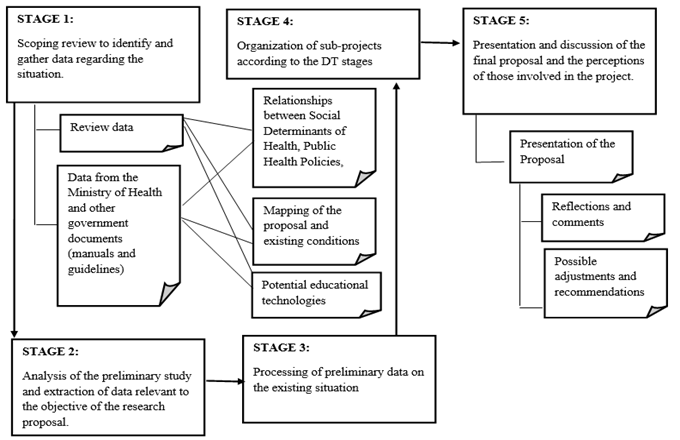
In the first stage of research planning, two scoping reviews were designed to identify the technologies used in health education within Primary Health Care (PHC) regarding Socially Determined Diseases (SDDs) and the causes of (de)motivation for self-care. Both reviews will be conducted as preliminary studies, following the five recommended stages: a) defining the research question; b) identifying relevant studies; c) selecting studies; d) mapping data; and e) comparing, summarizing, and reporting findings, in accordance with the Preferred Reporting Items for Systematic Reviews and Meta-Analyses Extension for Scoping Reviews (PRISMA-ScR) guidelines (11).
The second stage will consist of a preliminary analysis of the results from these reviews, aiming to guide subsequent empirical studies, including ecological analyses, cross-sectional studies, and research using the Grounded Theory approach.
In this same context, regarding the second and third stages, the theoretical framework adopted the National Guidelines for the Program for the Elimination of Tuberculosis and Other Socially Determined Diseases (PBS), an initiative falling under the scope of the Interministerial Committee for the Elimination of Tuberculosis and Other Socially Determined Diseases (Ciedds). Published in 2023 and updated in 2024, the document establishes strategic guidelines to support the development of the Program's Operational and Evaluation Plan. These guidelines emphasize the need for coordinated actions across various government and social sectors, with active civil society participation, to address the socioeconomic and environmental conditions that perpetuate the occurrence of 11 socially determined diseases and five socially determined infections (12).
Continuing the data process, the fourth stage involves the organization and development of sub-projects; these are structured by chapter to detail the intended research trajectory and present the methodological procedures. The meetings outlined in the flowchart for the fifth stage addressed the main challenges in disseminating reliable information to the public, such as the difficulties vulnerable populations face in accessing health services for Socially Determined Diseases (SDDs), the disconnect between these populations and their reference health teams, the spread of fake news, and resistance to disease prevention and health promotion efforts. In light of this, a project was established to develop information tools aimed at combating misinformation and addressing SDDs, specifically through the creation of instructional manuals designed for health professionals and social movements.
These meetings took place over a four-week period using a hybrid format that combined in-person sessions with virtual gatherings via Google Meet. Each meeting lasted approximately one hour and involved the professionals responsible for conducting the research and defining the strategies that guided the project's development.
RESULTS AND DISCUSSION
The participatory development of an inter-institutional Project, drawing on diverse experiences and forms of knowledge, reinforces the value placed on territorial plurality and acknowledges the situated knowledge held by the teams and the population involved. Beyond the shared construction of potential pathways, the dialogue among various stakeholders (5) allows for the accommodation of diverse practices, forms of knowledge, and interests. This process aligns directly with PBS guidelines by promoting social inclusion, strengthening Primary Health Care (PHC), and fostering integration among academia, health services, and the community to tackle Social Determinants of Health (SDH).
By bringing together students, health professionals, faculty members, managers, and representatives from public institutions, it was possible to identify points of tension in communication with the public, particularly regarding the rise of misinformation and the impact of social inequalities on access to reliable information. This collaborative analysis contributed to achieving PBS objectives by informing the creation of educational strategies that are more sensitive to sociocultural contexts, emphasizing accessible language, respect for cultural diversity, and the promotion of health literacy—all fundamental pillars of the program (12).
Furthermore, the process revitalized ties between the university and health services, intensifying the creation of collaborative networks and expanding opportunities for listening and mutual learning—actions directly linked to PBS goals of strengthening governance and social participation. Through horizontal dialogue among participants developing the research proposal, respecting the collective construction process and the specificities of each population, the strategy demonstrated transformative potential in gathering perspectives and combating misinformation within interdisciplinary practices.
Analyzing the workflows outlined in the project design, combined with the prior identification of gaps and potential solutions, provided essential input for decision-making during the project's initial conceptual phase. Aligning with the PBS through its use of participatory methodologies, and taking into account the identified challenges and the need for innovative responses centered on the population's actual needs, the team opted for a Design Thinking (DT) methodological approach, based on the stages of inspiration, ideation, and implementation. This choice made it possible to minimize uncertainties, reduce the risk of rework, and ensure greater alignment between project objectives and the needs expressed by researchers, professionals, and managers. Consequently, the methodological detailing, organized into 11 interconnected sub-projects, enabled actions to be structured and implemented progressively, with a focus on digital inclusion, equity in care, and the strengthening of Primary Health Care (PHC), the core goals of the PBS.
One possibility, frequently observed during the development of health projects, arises when a group's accumulated experience in specific areas, such as health literacy and the development of educational technologies, allows for the identification of gaps not yet addressed by strategies to tackle Social Determinants of Health (SDH) (5). The group's prior knowledge, consolidated over years of work with educational practices and health literacy across various contexts, combined with expertise in the use of ICTs, led to the realization that traditional health education actions were insufficient to meet the challenges posed by misinformation and low adherence to prevention and treatment practice (7). This insight proved fundamental to the maturation of the proposal, guiding the development of an innovative project that integrated accumulated knowledge with new technological approaches, designed appropriately and collaboratively for the target audience.
Thus, it is possible to reflect on the limitations of the educational strategies previously implemented by the academic research group, which may not have adequately addressed the challenges posed by SDH; furthermore, reflections grounded in the critical analysis of how to tackle SDH, led by health managers, highlighted the need to incorporate new methodologies capable of handling the complexity of misinformation flows.
This situation made it possible to adapt previously developed theoretical frameworks and pedagogical, technological, and innovation tools, thereby enabling a more effective approach when working with vulnerable groups. Consequently, the process of refining the research project idea resulted not only in the identification of weaknesses but also in the ability to integrate existing knowledge with new, emerging demands.
Although the absence of community representatives during the initial research planning phase stands out as a limitation of this study, the intersectoral development process demonstrated the consistency needed to inform strategic decisions and anticipate challenges, in alignment with the PBS. The study highlights how the development and implementation of innovative, participatory projects can contribute to achieving the PBS objectives, particularly in overcoming social health inequalities and strengthening collaborative networks within the territory.
FINAL CONSIDERATIONS
Planning this participatory Project, focused on developing ICTs to combat misinformation, underscored the importance and necessity of further participatory research and production. Such initiatives can more effectively map gaps regarding Social Determinants of Health (SDH), serving as tools to enhance the care provided, particularly within the scope of Primary Health Care (PHC).
In this context, the relevance of research planning grounded in participatory perspectives for combating misinformation stands out; this approach impacts the care provided and drives changes in PHC health practices, given that the concept of SDH transcends the traditional health-disease dichotomy, requiring a broader, holistic professional outlook.
This experience demonstrated significant potential to support nurses in developing and implementing local-level projects, as the practical knowledge gained through collective, participatory processes can be adapted to diverse local realities. The methodology employed, centered on intersectoral dialogue and respect for territorial specificities, offers a viable pathway for nurses to lead the planning and execution of interventions aligned with the community's actual needs, thereby strengthening their role in addressing SDH and combating misinformation.
Thus, it is concluded that the engaged and integrated participation of various stakeholders in research project development, combined with practical and theoretical experience, is essential for refining outreach initiatives and creating innovative solutions, paving the way for nursing to take a leading role in driving strategic projects within the community.
REFERENCES
1. Buss PM, Pellegrini Filho A. A saúde e seus determinantes sociais. Rev Saúde Pública. 2007;41(3):1-5.
2. Ribeiro A. Saúde digital, inovação e tecnologias no SUS. In: Saúde Digital em Foco. Curitiba: Ed. UFPR; 2020.
3. Brasil. Comitê Interministerial para a Eliminação da Tuberculose e de Outras Doenças Determinadas Socialmente. Diretrizes Nacionais do Programa Brasil Saudável: unir para cuidar. Brasília-DF: Ministério da Saúde; 2025.
4. Bender JD, Facchini LA, Lapão LMV, Tomasi E, Thumé E. O uso de Tecnologias de Informação e Comunicação em Saúde na Atenção Primária à Saúde no Brasil, de 2014 a 2018. Ciênc saúde coletiva. 2024;29(1): e19882022.
5. Passamai MPB, Sampaio HAC, Dias AMI, Cabral LA. Letramento funcional em saúde: reflexões e conceitos sobre seu impacto na interação entre usuários, profissionais e sistema de saúde. Interface (Botucatu). 2012;16(41):301–14.
6. Instituto de Estudos para Políticas de Saúde (IEPS). Inovação no SUS: proposta de modelo para um ecossistema de inovação em saúde no Brasil. São Paulo: IEPS; 2021.
7. Freire NP, Cunha ICKO, Ximenes Neto FRG, Vargas FL, Santiago BK de A, Lourenção LG. Impactos da infodemia sobre a COVID-19 para profissionais de saúde no Brasil. Ciênc saúde coletiva. 2023;28(10):3045–56.
8. Coelho M, Martins G, Andrade E. Infodemia e desinformação em saúde: um desafio contemporâneo. Interface (Botucatu). 2023;27:e220183.
9. Brown T. Design Thinking: uma metodologia poderosa para decretar o fim das velhas ideias. Rio de Janeiro: Alta Books; 2020.
10. Conselho Nacional de Saúde (BR). Resolução n.º 674, de 6 de maio de 2022. Diário Oficial da União. 2022 out 25; Seção I:160-3. Disponível em: https://www.gov.br/conselho-nacional-de-saude/pt-br/atos-normativos/resolucoes/2022/resolucao-no-674.pdf/view. Acesso em: 2025 jul 07.
11. Tricco AC, Lillie E, Zarin W, O’Brien KK, Colquhoun H, Levac D, et al. PRISMA Extension for Scoping Reviews (PRISMA-ScR): Checklist and Explanation. Ann Intern Med. 2018;169(7):467-73.
12. Ministério da Saúde (BR). Participa + Brasil - Diretrizes Nacionais do Programa Brasil Saudável - Unir para Cuidar. 2024 [citado 07 Jun 2025]. Disponível em: https://www.gov.br/participamaisbrasil/diretrizes-nacionais-do-programa-brasil-saudavel.
Funding and Acknowledgments:
This study was supported by the Coordination for the Improvement of Higher Education Personnel – Brazil (CAPES) – Funding Code 001.
Conflict of interest statement
None to declare.
Data availability statement
No datasets were generated in this study. The information presented is described in the body of the article.
Authorship criteria (author contributions)
1. Substantial contribution to the conception and/or planning of the study: Eloise Panagio Silva, Aldo Lopes da Costa Júnior, Maria Julia Yunis Sarpi, Guilherme Malaquias Silva, Marcela Fernandes Travagim, Rafaela Ferreira Machado, Vanessa Denardi Antoniassi Baldissera.
2. Acquisition, analysis, and/or interpretation of data: Eloise Panagio Silva, Aldo Lopes da Costa Júnior, Maria Julia Yunis Sarpi, Guilherme Malaquias Silva, Marcela Fernandes Travagim, Rafaela Ferreira Machado, Vanessa Denardi Antoniassi Baldissera.
3. Drafting and/or critical revision and final approval of the published version: Eloise Panagio Silva, Aldo Lopes da Costa Júnior, Maria Julia Yunis Sarpi, Guilherme Malaquias Silva, Marcela Fernandes Travagim, Rafaela Ferreira Machado, Vanessa Denardi Antoniassi Baldissera.
Scientific Editor: Ítalo Arão Pereira Ribeiro. ORCID: https://orcid.org/0000-0003-0778-1447
Rev Enferm Atual In Derme 2026;100(3): e026072