SCOPING REVIEW PROTOCOL
HOSPITAL INTERVENTIONS TO PROMOTE MATERNAL SELF-EFFICACY IN THE IMMEDIATE POSTPARTUM PERIOD: A SCOPING REVIEW PROTOCOL
INTERVENÇÕES HOSPITALARES PARA A PROMOÇÃO DA AUTOEFICÁCIA MATERNA NO PUERPÉRIO IMEDIATO: PROTOCOLO DE REVISÃO DE ESCOPO
INTERVENCIONES HOSPITALARIAS PARA PROMOVER LA AUTOEFICACIA MATERNA EN EL PERÍODO POSPARTO INMEDIATO: UN PROTOCOLO DE REVISIÓN DE ALCANCE
https://doi.org/10.31011/reaid-2026-v.100-n.3-art.2737
1Marina Mezomo Soccal
2Cristina Saling Kruel
1Graduanda do Curso de Psicologia da Universidade Franciscana (UFN), Santa Maria, Rio Grande do Sul, Brazil. ORCID: https://orcid.org/0009-0001-2675-3233
2docente do Curso de Psicologia da Universidade Franciscana (UFN), Santa Maria, Rio Grande do Sul, Brazil. ORCID: https://orcid.org/0000-0003-1996-7708
Corresponding Author
Marina Mezomo Soccal
Rua Pinheiro Machado, 3069, Santa Maria – RS, Brazil. CEP 97050-601, phone: +55 (55) 99966-2232, E-mail: m.soccal@ufn.edu.br.
Submission: 19-02-2026
Approval: 12-07-2026
ABSTRACT
Introduction: In hospital maternity wards, postpartum women simultaneously experience processes of physical recovery, bonding with the newborn, and building confidence in their ability to provide maternal care, in a context frequently influenced by technical guidelines, institutional routines, and multiple healthcare professionals. In this setting, the construct of maternal self-efficacy has been widely used to understand a woman's perception of her ability to successfully perform tasks related to infant care. Objective: To map, within the scientific literature, the types, characteristics, professionals involved, and implementation contexts of hospital interventions aimed at promoting maternal self-efficacy in the immediate postpartum period, as well as to identify knowledge gaps on the subject. Methods: This is a scoping review protocol whose methodological structure is based on the guidelines established by JBI. After formulating the research question using the mnemonic Population, Concept, and Context, a search was conducted through the platforms Regional Portal of the Virtual Health Library, PubMed, Scientific Electronic Library Online, and Google Scholar, using adapted search strategies. The review will include original empirical studies, published between 2021 and 2026, in Portuguese or English, available in full text, that describe interventions performed in a hospital setting with women in the immediate postpartum period. Subsequently, the selection of articles will be made by reading their titles and abstracts, and data extraction will be performed by two independent reviewers using an instrument developed specifically for the review.
Keywords: Self Efficacy; Postpartum Period; Maternal and Child Health.
RESUMO
Introdução: Na maternidade hospitalar, as puérperas vivenciam simultaneamente processos de recuperação física, estabelecimento do vínculo com o recém-nascido e construção de confiança em sua capacidade de exercer o cuidado materno, em um contexto frequentemente atravessado por orientações técnicas, rotinas institucionais e múltiplos profissionais de saúde. Nesse cenário, o construto da autoeficácia materna tem sido amplamente utilizado para compreender a percepção da mulher acerca de sua capacidade de desempenhar com sucesso as tarefas relacionadas ao cuidado do bebê. Objetivo: Mapear, na literatura científica, os tipos, características, profissionais envolvidos e contextos de implementação das intervenções hospitalares destinadas à promoção da autoeficácia materna no puerpério imediato, bem como identificar lacunas de conhecimento sobre o tema. Métodos: Trata-se de um protocolo de revisão de escopo cuja estrutura metodológica se baseia nas diretrizes estabelecidas pelo JBI. Após a elaboração da pergunta de pesquisa mediante o mnemônico População, Conceito e Contexto, realizou-se uma busca nas plataformas Portal Regional da Biblioteca Virtual em Saúde, Pubmed, Scientific Electronic Library On-line e Google Acadêmico a partir de estratégias de busca adaptadas. A revisão incluirá estudos empíricos originais, publicados entre 2021 e 2026, em português ou inglês, disponíveis na íntegra, que descrevam intervenções realizadas em contexto hospitalar com puérperas no puerpério imediato. Posteriormente, a seleção dos artigos se dará por meio da leitura de seus títulos e resumos e, em seguida, a extração dos dados será realizada por dois revisores independentes com o uso de um instrumento elaborado para os fins da revisão.
Palavras-chave: Autoeficácia; Período Pós-parto; Saúde Materno-Infantil.
RESUMEN
Introducción: En unidades de maternidad, las puérperas experimentan simultáneamente procesos de recuperación física, vinculación con el bebé y desarrollo de confianza en su capacidad para brindar cuidados maternos, en un contexto frecuentemente influenciado por directrices técnicas, rutinas institucionales y múltiples profesionales de la salud. En este contexto, el concepto de autoeficacia materna se ha utilizado ampliamente para comprender la percepción de la mujer sobre su capacidad para realizar con éxito las tareas relacionadas con el cuidado del bebé. Objetivo: Mapear, en la literatura científica, los tipos, características, profesionales involucrados y contextos de implementación de las intervenciones hospitalarias dirigidas a la promoción de la autoeficacia materna en el posparto inmediato, así como identificar lagunas de conocimiento sobre el tema. Métodos: Este es un protocolo de revisión de alcance cuya estructura metodológica se basa en las directrices establecidas por JBI. Tras formular la pregunta de investigación mediante la regla mnemotécnica Población, Concepto y Contexto, se realizó una búsqueda en el Portal Regional de la Biblioteca Virtual en Salud, PubMed, Scientific Electronic Library On-line y Google Académico, empleando estrategias de búsqueda adaptadas. La revisión incluirá estudios empíricos originales, publicados entre 2021 y 2026, en portugués o inglés, disponibles en texto completo, que describan intervenciones hospitalares con mujeres en el puerperio inmediato. Posteriormente, la selección de los artículos se realizará mediante la lectura de sus títulos y resúmenes, y la extracción de datos será realizada por dos revisores independientes mediante un instrumento desarrollado específicamente para la revisión.
Palabras clave: Autoeficacia; Periodo Posparto; Salud Materno-Infantil.
INTRODUCTION
The immediate postpartum period is a time of intense physical, emotional, and relational changes in a woman's life, marked by the transition to motherhood and the need to adapt to new caregiving demands(1). During the postpartum hospital stay, women simultaneously undergo physical recovery, bond with their newborns, and build confidence in their ability to provide maternal care all within a context often shaped by technical guidelines, institutional routines, and interactions with multiple healthcare professionals(2,3). In this scenario, the construct of maternal self-efficacy, grounded in Bandura’s Social Cognitive Theory(4), has been widely used to understand a woman's perception of her ability to successfully perform tasks related to infant care(5).
Evidence indicates that higher levels of maternal self-efficacy are associated with better emotional outcomes, greater adherence to health guidelines, increased confidence in newborn care(6), better adaptation to the maternal role(7), and the maintenance of exclusive breastfeeding until the infant is six months old(8); conversely, lower levels may be linked to insecurity, anxiety, and postpartum psychological distress(9).
Although the literature offers a substantial body of research on maternal self-efficacy, much of the investigation focuses on specific outcomes, such as breastfeeding self-efficacy(8,10), or on interventions conducted in home settings(11). However, there is less systematized evidence regarding interventions implemented in hospital settings during the immediate postpartum period, a time considered strategic for supporting women and fostering positive early caregiving experiences. The hospital setting, in turn, constitutes a prime environment for implementing educational, psychological, nursing, and multiprofessional interventions, as well as relational technologies based on welcoming, active listening, and bonding, all of which can foster a sense of maternal competence(12). However, these interventions are scattered throughout the literature; they are described in various formats, conducted by different professionals, and grounded in diverse conceptual frameworks, making it difficult to systematically understand their characteristics, scope, and gaps.
Given this landscape, it is pertinent to conduct a scoping review to comprehensively map hospital-based interventions aimed at promoting maternal self-efficacy during the immediate postpartum period, identifying their types, formats, the professionals involved, and the contexts of implementation. Scoping reviews are particularly suitable when the goal is to explore the extent, variety, and characteristics of available evidence, as well as to clarify concepts and identify knowledge gaps. Furthermore, the research topic aligns closely with SDG 3 (Good Health and Well-being) of the United Nations (UN) 2030 Agenda(13), as it contributes to the improvement of maternal and child care.
A preliminary search on the Open Science Framework (OSF) and PROSPERO platforms identified no scoping review or systematic review protocols specifically focusing on hospital-based interventions aimed at promoting maternal self-efficacy during the immediate postpartum period. Existing reviews focus predominantly on breastfeeding-related self-efficacy or on broader postpartum timeframes, underscoring the need for a specific synthesis regarding this particular scope. Thus, this scoping review aims to map, within the scientific literature, the types, characteristics, professionals involved, and implementation contexts of hospital-based interventions designed to promote maternal self-efficacy during the immediate postpartum period, as well as to identify knowledge gaps on the subject.
METHODS
Study design
This is a scoping review, a methodology that allows for mapping and synthesizing research evidence on a specific topic. This methodology will enable the mapping of interventions administered in a hospital setting aimed at promoting maternal self-efficacy during the immediate postpartum period within the current scientific literature.
Methodological framework
The methodological guidelines established by JBI(14) for scoping reviews will be followed, comprising: identification of the research question; identification of relevant studies in the scientific literature; determination of eligibility and exclusion criteria; selection and assessment of studies; and data analysis. The review will be reported in accordance with the parameters of the Preferred Reporting Items for Systematic Reviews and Meta-Analyses – Extension for Scoping Reviews (PRISMA-ScR)(15). This protocol has been registered on the Open Science Framework (OSF) platform and can be accessed via the view-only link: https://osf.io/mwpnr/overview?view_only=bc15463df8fe4267b965baab2ab35e2f, created for the purpose of blinded review.
Research question
The PCC (Population, Concept, Context) mnemonic(14) guided the formulation of the research question. Based on this strategy, the following elements were identified: Population – women in the immediate postpartum period; Concept – interventions to promote maternal self-efficacy; and Context – hospital maternity setting. The following research question was then formulated using the PCC mnemonic: what hospital-based interventions for promoting maternal self-efficacy during the immediate postpartum period have been addressed in the current scientific literature?
Eligibility criteria
Original empirical studies, employing qualitative, quantitative, or mixed-methods approaches, published between 2021 and 2026 in Portuguese or English and available in full text will be included, provided they describe interventions conducted in a hospital setting with women in the immediate postpartum period. The five-year timeframe aims to capture recent evidence aligned with updated care practices in the post-COVID-19 pandemic context. Restricting the languages to Portuguese and English is justified because these are the predominant languages in international and national scientific literature regarding maternal and child health, and they align with the reviewers' language proficiency.
The immediate postpartum period is defined here as the time between delivery and the 10th day postpartum, in accordance with the classification adopted by the Brazilian Ministry of Health(16); this encompasses both the woman's hospital stay for postpartum recovery and instances where her hospital stay is extended, for example, while accompanying the newborn after her own obstetric discharge. Where available in the primary studies, the newborn's condition (healthy, in an intermediate/kangaroo care unit, or in the neonatal ICU) and the woman's clinical status in this context will be considered, given that maternal self-efficacy demands and the type of intervention tend to vary across these scenarios.
For the purposes of this review, hospital interventions are defined as any actions, practices, programs, or strategies developed within hospital maternity settings and conducted by healthcare professionals, either individually or as part of a team, with the explicit or implicit goal of strengthening the woman's perception of her capability to care for the newborn; this includes educational, psychological support, nursing, multiprofessional, or institutional initiatives. When the relationship between the intervention and maternal self-efficacy is not explicitly named in the primary study, inclusion will be determined by identifying at least one of the related constructs from Chart 1 (maternal confidence, maternal competence, or breastfeeding self-efficacy) as an assessed outcome, subject to agreement between the two independent reviewers, with a third reviewer consulted in the event of disagreement.
Review articles, theoretical essays, study protocols, editorials, and letters will be excluded; as will studies involving no intervention; studies where interventions took place exclusively in home, outpatient, or community settings; studies where interventions were conducted after hospital discharge; and studies addressing only physical or clinical outcomes unrelated to maternal perceptions of capability, confidence, or self-efficacy.
Information sources and search strategies
The search was conducted on February 5, 2026, using Virtual Health Library (VHL) Regional Portal, PubMed, and Scientific Electronic Library Online (SciELO) platforms. Additionally, a search on Google Scholar on the same date considered the first 100 results, sorted by relevance. Limiting the search to the first 100 results sorted by relevance follows the recommendation of Haddaway et al.(17), who demonstrated a significant drop in relevance among Google Scholar records after the initial results pages, making this cutoff a standard practice in scoping and systematic reviews. The Health Sciences Descriptors (Descritores em Ciências da Saúde – DeCS) used, along with their synonyms and English-language equivalents (Medical Subject Headings – MeSH), are listed in Chart 1, aligned with the PCC mnemonic. In addition to controlled descriptors, free-text keywords will be used to increase search sensitivity, accounting for conceptual variations of the maternal self-efficacy construct. The descriptors were combined using the Boolean operators OR and AND into search strategies tailored to each platform, as shown in Chart 2.
Chart 1 – Correspondence of descriptors and keywords to the PCC mnemonic. Santa Maria, Rio Grande do Sul, Brazil, 2026.
|
PCC MNEMONIC |
MACRO DESCRIPTORS |
SYNONYMOUS DESCRIPTORS |
KEYWORDS |
|
POPULATION: women in the immediate postpartum period |
DeCS postpartum period |
DeCS "Postpartum women" OR "Postpartum period" |
- |
|
MeSH Postpartum Period |
MeSH "Period, Postpartum" OR "Postpartum" OR "Postpartum Women" OR "Women, Postpartum" OR "Puerperium" |
||
|
CONCEPT: interventions to promote maternal self-efficacy |
DeCS Self Efficacy |
DeCS - |
"confiança materna" OR "competência materna" OR "maternal confidence" OR "maternal competence" OR "parenting confidence" OR "perceived competence" |
|
MeSH Self Efficacy |
MeSH - |
||
|
CONTEXT: hospital maternity ward |
DeCS Hospitals OR Delivery Rooms OR Hospitalization |
DeCS "Hospital" OR "Hospital Center" OR "Hospital Centers" OR "Hospital" OR "Hospitals" OR "Obstetric Center" OR "Hospital Obstetric Center" OR "Delivery Room" OR "Hospitalization" |
- |
|
MeSH Hospitals OR Delivery Rooms OR Birthing Center OR Hospitalization |
MeSH "Hospital" OR "Birth Center, Hospital" OR "Birth Centers, Hospital" OR "Birthing Center, Hospital" OR "Birthing Centers, Hospital" OR "Center, Hospital Birth" OR "Center, Hospital Birthing" OR "Centers, Hospital Birth" OR "Centers, Hospital Birthing" OR "Delivery Room" OR "Hospital Birth Center" OR "Hospital Birth Centers" OR "Hospital Birthing Center" OR "Hospital Birthing Centers" OR "Room, Delivery" OR "Rooms, Delivery" OR "Hospitalizations" |
Source: Research data. Santa Maria, RS, Brazil, 2026.
Chart 2 – Search platforms, respective search strategies, and numerical results obtained on February 5, 2026. Santa Maria, Rio Grande do Sul, Brazil, 2026.
|
PLATAFORM |
SERCH STRATEGY |
RESULTS |
|
Regional Portal of the Virtual Health Library (VHL) |
Title, abstract, subject = (("Autoeficacia" OR "Self Efficacy" OR "confiança materna" OR "competência materna" OR "maternal confidence" OR "maternal competence" OR "parenting confidence" OR "perceived competence") AND ("Periodo Pos-Parto" OR "Puerperas" OR "Puerperio" OR "Postpartum Period" OR "Period, Postpartum" OR "Postpartum" OR "Postpartum Women" OR "Women, Postpartum" OR "Puerperium") AND ("Hospitais" OR "Salas de Parto" OR "Hospitals" OR "Delivery Rooms" OR "Hospital" OR "Centro Hospitalar" OR "Centros Hospitalares" OR "Nosocômio" OR "Nosocômios" OR "Centro Obstétrico" OR "Centro Obstétrico Hospitalar" OR "Sala de Parto" OR "Birth Center, Hospital" OR "Birth Centers, Hospital" OR "Birthing Center, Hospital" OR "Birthing Centers, Hospital" OR "Center, Hospital Birth" OR "Center, Hospital Birthing" OR "Centers, Hospital Birth" OR "Centers, Hospital Birthing" OR "Delivery Room" OR "Hospital Birth Center" OR "Hospital Birth Centers" OR "Hospital Birthing Center" OR "Hospital Birthing Centers" OR "Room, Delivery" OR "Rooms, Delivery" OR "Hospitalização" OR "Internação Hospitalar" OR "Hospitalization" OR "Hospitalizations")) AND fulltext:("1") AND la:("en" OR "pt") AND (year_cluster:[2021 TO 2026]) AND instance:"regional" |
188
(Complete VHL collection) |
|
PubMed |
(("Self Efficacy"[All Fields] OR "maternal confidence"[All Fields] OR "maternal competence"[All Fields] OR "parenting confidence"[All Fields] OR "perceived competence"[All Fields]) AND ("Postpartum Period"[All Fields] OR "Period, Postpartum"[All Fields] OR "Postpartum"[All Fields] OR "Postpartum Women"[All Fields] OR "Women, Postpartum"[All Fields] OR "Puerperium"[All Fields]) AND ("Hospitals"[All Fields] OR "Delivery Rooms"[All Fields] OR "Hospital"[All Fields] OR "Birth Center, Hospital"[All Fields] OR "Birth Centers, Hospital"[tiab:~0] OR "Birthing Center, Hospital"[tiab:~0] OR "Birthing Centers, Hospital"[tiab:~0] OR "Center, Hospital Birth"[tiab:~0] OR "Center, Hospital Birthing"[tiab:~0] OR "Centers, Hospital Birth"[tiab:~0] OR "Centers, Hospital Birthing"[tiab:~0] OR "Delivery Room"[All Fields] OR "Hospital Birth Center"[All Fields] OR "Hospital Birth Centers"[All Fields] OR "Hospital Birthing Center"[All Fields] OR "Hospital Birthing Centers"[All Fields] OR "Room, Delivery"[All Fields] OR "Rooms, Delivery"[All Fields] OR "Hospitalization"[All Fields] OR "Hospitalizations"[All Fields])) AND ((y_5[Filter]) AND (ffrft[Filter]) AND (english[Filter] OR portuguese[Filter])) |
203 |
|
Scientific Electronic Library On-line (SciELO) |
All indices = ((Autoeficacia) OR (Self Efficacy) OR (confiança materna) OR (competência materna) OR (maternal confidence) OR (maternal competence) OR (parenting confidence) OR (perceived competence)) AND ((Periodo Pos-Parto) OR (Puerperas) OR (Puerperio) OR (Postpartum Period) OR (Period, Postpartum) OR (Postpartum) OR (Postpartum Women) OR (Women, Postpartum) OR (Puerperium)) AND ((Hospitais) OR (Salas de Parto) OR (Hospitals) OR (Delivery Rooms) OR (Hospital) OR (Centro Hospitalar) OR (Centros Hospitalares) OR (Nosocômio) OR (Nosocômios) OR (Centro Obstétrico) OR (Centro Obstétrico Hospitalar) OR (Sala de Parto) OR (Birth Center, Hospital) OR (Birth Centers, Hospital) OR (Birthing Center, Hospital) OR (Birthing Centers, Hospital) OR (Center, Hospital Birth) OR (Center, Hospital Birthing) OR (Centers, Hospital Birth) OR (Centers, Hospital Birthing) OR (Delivery Room) OR (Hospital Birth Center) OR (Hospital Birth Centers) OR (Hospital Birthing Center) OR (Hospital Birthing Centers) OR (Room, Delivery) OR (Rooms, Delivery) OR (Hospitalização) OR (Internação Hospitalar) OR (Hospitalization) OR (Hospitalizations)) Filters: (Publication Year: 2022) (Publication Year: 2023) (Publication Year: 2024) (Publication Year: 2025) (Publication Year: 2021) (Language: Portuguese) (Language: English) |
28 |
|
Google Scholar |
(("Self-efficacy" OR "maternal confidence" OR "maternal competence") AND ("Postpartum period" OR "Postpartum women" OR "Puerperium") AND ("Hospitals" OR "Delivery rooms" OR "Hospital" OR "Hospital center" OR "Hospital centers" OR "Obstetric center" OR "Hospital obstetric center" OR "Delivery room" OR "Hospitalization" OR "Hospital admission")) Specific period: 2021–2026 Excluding citations |
First 100
(out of an approximate total of 1,100 results) |
Source: Research data. Santa Maria, RS, Brazil, 2026.
Study selection process
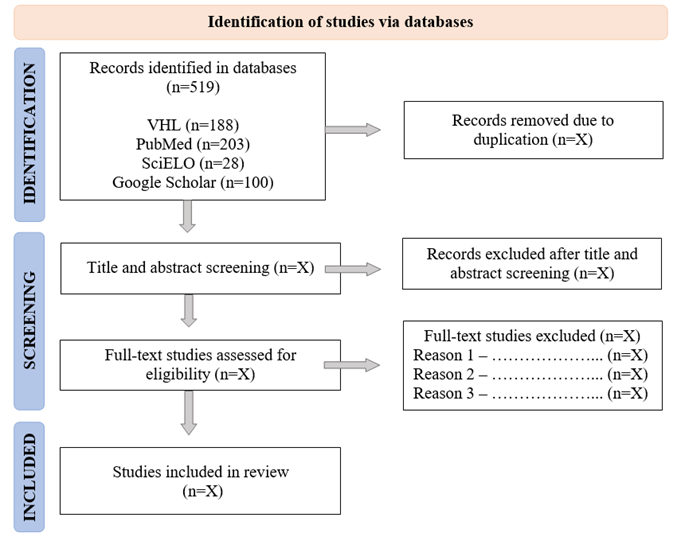
All records identified in the databases will be exported in RIS or NBIB format and imported into Rayyan platform(18). This tool will be used to identify and remove duplicates. Study screening will take place in two stages. In the first stage, two independent reviewers will screen titles and abstracts, applying the pre-established eligibility criteria. In the second stage, the full texts of potentially eligible studies will be independently evaluated by the same reviewers. Reasons for exclusion at this stage will be recorded and presented in a specific table. In the event of disagreement at any stage, a third reviewer will be consulted for a final decision. The selection process will be presented via a flow diagram based on the PRISMA-ScR recommendation(15) (Figure 1).
Figure 1 - Study selection flow diagram based on the PRISMA-ScR recommendation(15). Santa Maria, Rio Grande do Sul, Brazil, 2026.
Source: Research data. Santa Maria, RS, Brazil, 2026.
Data extraction process for selected studies
Data extraction will be performed by two independent reviewers using an extraction tool (Table 3) previously created in a spreadsheet (Microsoft Excel®) and developed specifically for this review. Prior to the final extraction, a pilot test will be conducted with a subset of the included studies to verify the suitability of the fields and align the reviewers' understanding. Adjustments to the tool may be made if necessary, with all modifications documented.
The following data will be extracted: study identification (author, year, country, and journal); methodological characteristics (objective, study design, approach, sample, and hospital setting); intervention characteristics (type, format, technology classification(19), professionals involved, timing of application, and duration); relationship to the maternal self-efficacy construct (concept used, assessment tools, dimensions addressed, and promotion strategies); and main findings, practical implications, and key conclusions. The “technology classification” variable is based on the typology proposed by Merhy(19), which categorizes health technologies according to the following operational application criteria: light technologies, corresponding to relational practices such as welcoming, attentive listening, and bond-building; light-hard technologies, referring to structured knowledge, including protocols, scales, and other systematized tools; and hard technologies, related to equipment and electronic devices. Disagreements between reviewers will be resolved by consensus or by consulting a third reviewer.
Chart 3 - Study data extraction tool. Santa Maria, Rio Grande do Sul, Brazil, 2026.
|
DATA |
VARIABLE |
DESCRIPTION |
|
Study identification |
Author |
Authorship of the study |
|
Year |
Year of study publication |
|
|
Country |
Country where the study was conducted |
|
|
Periodic |
Journal in which the study was published |
|
|
Methodological characteristicsproach |
Objective |
Study objective |
|
Study design |
Classification based on nature (basic or applied), objectives (exploratory, descriptive, or explanatory), and procedures (observational research, ethnographic research, action research, etc.) |
|
|
Aproach |
Qualitative and/or quantitative |
|
|
Sample |
Study sample |
|
|
Hospital Context |
Obstetric Center; Nursery; Maternity Ward; Neonatal ICU; Other |
|
|
Characteristics of the intervention |
Type |
Psychological intervention; nursing intervention; multiprofessional intervention; educational program; institutional protocol; guided visit; group intervention; other |
|
Format |
Manual; guide; booklet; leaflet; app; telephone/text message intervention; light technology (welcoming, listening, bonding); other |
|
|
Technology classification |
Light (welcoming, listening, rapport-building); light-hard (protocol, scale, or other systematized instrument); hard (equipment, electronic device) |
|
|
Professionals involved |
Number of professionals involved in the intervention |
|
|
Time of application |
Timing during the immediate postpartum period when the intervention was applied (e.g., 1 hour after delivery; 24 hours after delivery) |
|
|
Duration |
Duration of the intervention |
|
|
Relationship with the construct of maternal self-efficacy |
Concept used |
“Maternal self-efficacy”; “maternal confidence”; “maternal competence”; other |
|
Assessment instruments |
Instruments used to assess maternal self-efficacy or related constructs, including standardized scales (e.g., Maternal Self-Efficacy Scale, Parenting Sense of Competence Scale, Breastfeeding Self-Efficacy Scale), adapted or non-validated instruments, structured questionnaires developed by the authors, interviews, focus groups, clinical observation, narrative records, or the absence of a formal instrument, where applicable. |
|
|
Dimensions addressed |
Dimensions of maternal self-efficacy addressed by the intervention, such as: confidence in newborn care (hygiene, handling, sleep); breastfeeding self-efficacy; perceived competence in the maternal role; maternal responsiveness and mother-infant bonding; emotional regulation and coping with the demands of the postpartum period; decision-making regarding care; or other dimensions specified or inferred from the study data. |
|
|
Promotion strategies |
Strategies used to promote maternal self-efficacy, including, among others: health education; practical guidance and care demonstrations; positive reinforcement; emotional validation; attentive listening; psychological support; encouragement of autonomy; building a bond with professionals; behavioral modeling; information sharing; ongoing support; or relational strategies implicit in care practices. |
|
|
Key findings and practical implications |
- |
Findings related to the promotion of maternal self-efficacy and practical implications, including perceived or measured effects of the intervention (e.g., increased maternal confidence, greater caregiving security, reduced insecurity or anxiety, strengthened mother-infant bond), as well as authors' recommendations for clinical, organizational, or multidisciplinary practice in the hospital setting. |
|
Main conclusion |
- |
Main conclusion of the study |
Source: Prepared by the authors. Santa Maria, RS, Brazil, 2026.
Data analysis and synthesis
Data analysis will be based on Content Analysis(17). The corpus will consist of the descriptions of interventions found in the included studies. Units of analysis will correspond to intervention characteristics (type, professionals involved, format, duration, strategies used, and self-efficacy dimensions addressed), while units of context will correspond to the primary studies.
The analysis will comprise the stages of pre-analysis (corpus organization and preliminary reading), material exploration (systematic coding and categorization), and treatment of results (category organization and descriptive synthesis of findings). Results will be presented via tables, charts, and a narrative synthesis, aiming to map patterns, variations, and gaps in the literature.
Ethical aspects
All works used in the research will be duly cited and referenced, and their copyrights will be respected.
REFERENCES
1. Strapasson MR, Nedel MNB. Puerpério imediato: desvendando o significado da maternidade. Rev Gaúcha Enferm. 2010;31(3):521-528. doi: 10.1590/S1983-14472010000300016
2. Tavares D, Quevedo L, Jansen K, Souza LDM, Pinheiro RT, Silva RA, et al. Prevalence of suicide risk and comorbidities in postpartum women in Pelotas. Braz J Psychiatry. 2012;34(3):270-6. doi:10.1016/j.rbp.2011.12.001.
3. Campos PA, Féres-Carneiro T. Sou mãe: e agora? Vivências do puerpério. Psicol USP. 2021;32:e200211. doi: 10.1590/0103-6564e200211.
4. Bandura A. Autoeficácia: rumo a uma teoria unificadora da mudança comportamental. Psychol Rev [Internet]. 1977; 84(2):191-215. doi: 10.1037/0033-295X.84.2.191.
5. Tristão RM, Neiva ER, Barnes CR, Adamson-Macedo E. Validation of the scale of perceived self-efficacy of maternal parenting in brazilian sample. J. Hum. Growth Dev. 2015; 25(3):277-86. doi: 10.7322/jhgd.96759.
6. Spehar MC, Seidl EMF. Percepções maternas no Método Canguru: contato pele a pele, amamentação e autoeficácia. Psicol Estud. 2013;18(4):647-56. doi: 10.1590/S1413-73722013000400007.
7. Dlamini LP, Hsu YY, Shongwe MC, Wang ST, Gau ML. Maternal self-efficacy as a mediator in the relationship between postpartum depression and maternal role competence: a cross-sectional survey. J Midwifery Womens Health. 2023;68(4):499-506. doi: 10.1111/jmwh.13478.
8. Dodou HD, Bezerra RA, Chaves AFL, Vasconcelos CTM, Barbosa LP, Oriá MOB. Telephone intervention to promote maternal breastfeeding self-efficacy: randomized clinical trial. Rev Esc Enferm USP. 2021;55:e20200520. doi: 10.1590/1980-220X-REEUSP-2020-0520.
9. Finlayson K, Crossland N, Bonet M, Downe S. What matters to women in the postnatal period: a meta-synthesis of qualitative studies. PLoS One. 2020;15(4):e0231415. doi: 10.1371/journal.pone.0231415.
10. Silva MV, Machado RZ, Bittencourt VFZ, Bittencourt MF, Willig DQ, Iser BPM. Breastfeeding self-efficacy in postpartum woman. Healthcare. 2025;13(14):1690. doi: 10.3390/healthcare13141690.
11. Pádua AR, Melo EM, Alvarelhão JJ. An intervention program based on regular home visits for improving maternal breastfeeding self-efficacy: a pilot study in Portugal. Matern Child Health J. 2022;26(3):575-86. doi: 10.1007/s10995-021-03361-7.
12. Fasanghari M, Keramat A. Investigating the effect of educational interventions on maternal competence: a systematic review and meta-analysis. J Educ Health Promot. 2023;12:254. doi: 10.4103/jehp.jehp_25_23.
13. Instituto de Pesquisa Econômica Aplicada (IPEA). Agenda 2030: objetivos de desenvolvimento sustentável: avaliação do progresso das principais metas globais para o Brasil: ODS 3: assegurar uma vida saudável e promover o bem-estar para todas e todos, em todas as idades. Brasília: Ipea; 2024. doi: 10.38116/ri2024ODS3.
14. Aromataris E, Lockwood C, Porritt K, Pilla B, Jordan Z, editors. JBI Manual for Evidence Synthesis. JBI. 2024. doi: 10.46658/JBIMES-24-01.
15. Tricco AC, Lillie E, Zarin W, O’brien KK, Colquhoun H, Levac D et al. PRISMA extension for scoping reviews (PRISMA-ScR): checklist and explanation. Ann Intern Med [Internet]. 2018;169(7):467-73. doi: 10.7326/M18-0850.
16. Ministério da Saúde (BR). Protocolos da atenção básica: saúde das mulheres. Brasília: Ministério da Saúde; 2016. 230 p.
17. Haddaway NR, Collins AM, Coughlin D, Kirk S. The role of Google Scholar in evidence reviews and its applicability to grey literature searching. PLoS ONE. 2015;10(9):e0138237. doi: 10.1371/journal.pone.0138237.
18. Ouzzani M, Hammady H, Fedorowicz Z, Elmagarmid A. Rayyan-a web and mobile app for systematic reviews. Syst Rev. 2016 Dec 5;5(1):210. doi: 10.1186/s13643-016-0384-4.
19. Merhy EE. Saúde: a cartografia do trabalho vivo. São Paulo: Hucitec; 2002.
20. Bardin L. Análise de conteúdo. São Paulo: Edições 70; 2016.
Funding and Acknowledgments
The research received no funding.
Conflict of Interest Statement
None to declare.
Data Availability Statement
No datasets were generated in this study. The information presented is described in the body of the article.
Authorship Criteria (Author Contributions)
Marina Mezomo Soccal: 1. contributed substantially to the conception and planning of the study; 2. to the acquisition, analysis, and interpretation of data; 3. to the drafting of the published version.
Cristina Saling Kruel: 1. contributed substantially to the conception of the study; 2. to the analysis and interpretation of data; 3. to the drafting, critical revision, and final approval of the published version.
Scientific Editor: Ítalo Arão Pereira Ribeiro. ORCID: https://orcid.org/0000-0003-0778-1447
Rev Enferm Atual In Derme 2026;100(3): e026074