https://doi.org/10.31011/reaid-2026-v.100-n.3-art.2801
Beatriz
Sousa Nunes
2Rosana
Alves de Melo
3Fernanda
Emília Xavier de Souza
4Flávia
Emília Cavalcante Valença Fernandes
1Universidade
Federal do Vale do São Francisco (UNIVASF). Petrolina, Brazil, https://orcid.org/0000-0003-1368-1709.
2Universidade
Federal do Vale do São Francisco (UNIVASF). Petrolina, Brazil, https://orcid.org/0000-0001-9217-921X
3Universidade
Federal do Vale do São Francisco (UNIVASF). Petrolina, Brazil, https://orcid.org/0000-0001-7055-375X
4Universidade
de Pernambuco. Recife, Brazil. https://orcid.org/0000-0003-2840-8561
Corresponding
Author
Ana
Beatriz Sousa Nunes
Rua
Jurema Preta, bairro Jatobá, Petrolina, Pernambuco, Brazil. CEP 56332-250. Phone:
+55 87 8839-9779 - E-mail: anaetomarerapeuta@gmail.com
Submission: 12-05-2026
Approval: 20-07-2026
ABSTRACT
Objective: to identify scientific evidence regarding
wound hygiene practices in healthcare, focusing on the characterization of
existing protocols and the main interventions reported in the literature.
Method: a scoping review conducted according to the Joanna Briggs
Institute methodology and PRISMA-ScR guidelines. The research was performed in
the PubMed, Scopus, Web of Science, and CINAHL databases, covering studies
published in the last five years. Results: the most frequently described
interventions included the use of antimicrobial solutions for cleansing,
debridement of devitalized tissue, and the use of advanced dressings. It was
observed that early biofilm management and wound bed preparation are essential
for therapeutic success. Conclusion: significant gaps were found in the
standardization of these approaches, reinforcing the need to develop and
validate an updated, evidence-based protocol for clinical practice, aiming to
reduce complications and improve the quality of care.
Keywords: Enterostomal Therapy; Wounds and Injuries;
Nursing Care; Clinical Protocols.
RESUMO
Objetivo: identificar as evidências científicas
sobre as práticas de higiene de feridas na assistência à saúde, com foco na
caracterização de protocolos existentes e nas principais intervenções relatadas
na literatura. Método: revisão de escopo, conduzida conforme a metodologia
do Joanna Briggs Institute e as diretrizes do PRISMA-ScR. A pesquisa foi
realizada nas bases PubMed, Scopus, Web of Science e CINAHL, abrangendo estudos
dos últimos cinco anos. Resultados: as intervenções mais frequentes
incluíram a utilização de soluções antimicrobianas para limpeza, a remoção de
tecido desvitalizado e o uso de curativos avançados. Observou-se que a
abordagem precoce contra biofilmes e a preparação do leito da ferida são fundamentais
para o sucesso terapêutico. Conclusão: constatou-se a existência de
lacunas significativas na padronização dessas abordagens, o que reforça a
necessidade de desenvolver e validar um protocolo atualizado e orientado por
evidências para a prática clínica, visando reduzir complicações e melhorar a
qualidade da assistência.
Palavras-chave: Estomaterapia; Ferimentos e
Lesões; Cuidados de Enfermagem; Protocolos Clínicos.
RESUMEN
Objetivo: identificar la evidencia científica sobre las prácticas de higiene
de heridas en la atención sanitaria, centrándose en la caracterización de los
protocolos existentes y en las principales intervenciones descritas en la
literatura. Método: una revisión de alcance (scoping review) realizada de acuerdo con
la metodología del Instituto Joanna Briggs y las directrices PRISMA-ScR. La
investigación se llevó a cabo en las bases de datos PubMed, Scopus, Web of
Science y CINAHL, abarcando estudios publicados en los últimos cinco años. Resultados:
las intervenciones descritas con mayor frecuencia incluyeron el uso de
soluciones antimicrobianas para la limpieza, el desbridamiento de tejido
desvitalizado y el uso de apósitos avanzados. Se observó que el manejo temprano
del biofilm y la preparación del lecho de la herida son fundamentales para el
éxito terapéutico. Conclusión: se encontraron brechas significativas en
la estandarización de estos enfoques, lo que refuerza la necesidad de
desarrollar y validar un protocolo actualizado y basado en evidencia para la
práctica clínica, con el objetivo de reducir las complicaciones y mejorar la
calidad de la atención.
INTRODUCTION
Wound hygiene is an
essential step in the care of skin lesions, playing a decisive role in
preventing infection and promoting efficient healing. Inadequate management of
these lesions can lead to serious complications, such as infections and delayed
healing, thereby directly affecting the patient's quality of life and
compromising treatment efficacy⁽¹⁻² ⁾.
However, despite its
importance, the lack of standardized hygiene practices remains a significant
gap in healthcare delivery⁽³⁻⁵⁾. The Wound Infection Institute⁽⁶⁾ highlights
the need for early interventions based on clinical signs and structured
assessment tools, reinforcing a patient-centered approach. Additionally, the
rational use of modern antiseptics and antimicrobial dressings is emphasized,
with due regard for tissue safety principles. Such evidence-based practices are
fundamental to preventing severe complications, such as sepsis and bacterial
resistance, through the implementation of well-defined protocols⁽⁶⁾.
In this context, the
appropriate choice of cleansing solutions and wound bed preparation are key
determinants of therapeutic success⁽³⁻⁵⁾. Wound bed preparation is a
fundamental concept in chronic wound management, as it addresses both the
underlying cause and the patient's specific needs, aiming to classify the wound
as healable, maintenance-oriented, or non-healable (palliative)⁽⁷⁾.
From this perspective,
this study is guided by the following question: What are the practices and
scientific evidence regarding wound hygiene in healthcare, and how can this
evidence inform the development of effective protocols? Thus, the present study
aimed to identify scientific evidence regarding wound hygiene practices in
healthcare, focusing on characterizing existing protocols and the main
interventions reported in the literature.
METHODS
This is a
scoping review conducted in accordance with the Joanna Briggs Institute (JBI)
guidelines and the Preferred Reporting Items for Systematic Reviews and
Meta-Analyses extension for Scoping Reviews (PRISMA-ScR) method⁽⁸⁾. The use of
this guide followed the EQUATOR Network recommendations to ensure
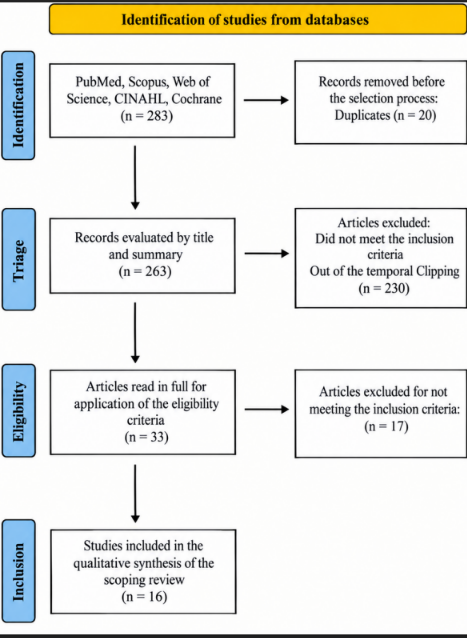
methodological rigor in the writing and presentation of the manuscript⁽⁸⁾ (Figura
1).
Figure
1
– PRISMA Flow diagram (adapted)
The search was conducted
across scientific databases using Health Sciences Descriptors (DeCS) and
Medical Subject Headings (MeSH), applying a combination of controlled terms
adapted for each platform. The databases consulted were: National Library of
Medicine (PubMed), Cochrane Library, Elsevier Scopus (Scopus), Web of Science,
and Cumulative Index to Nursing and Allied Health Literature (CINAHL).
Additionally, a search for gray literature was performed to capture technical
documents and non-indexed consensus statements.
The search terms used
were: “Wound care hygiene protocols”; “Wound infection prevention and
management”; “Antiseptic use in wound care”; “Wound dressing and infection
control”; and “Evidence-based wound care practices.” The choice of English
descriptors is justified by the international scope of the databases, allowing
access to global guidelines from organizations such as the WOCN, CDC, and
IWGDF.
Inclusion criteria
covered studies published between 2021 and 2025 that presented evidence on
wound management and hygiene protocols adopted by healthcare professionals,
with an emphasis on infection prevention and the optimization of healing.
Selection followed a two-phase process: the first consisted of screening titles
and abstracts by two independent reviewers; in the second, selected articles
were read in full. Duplicate studies or those that did not meet the criteria
were excluded. In the event of a discrepancy, a third reviewer was consulted.
Data were analyzed
qualitatively, focusing on the identification of key interventions. The
synthesis of results was organized in a narrative and descriptive manner,
highlighting the efficacy and safety of the identified practices and
categorizing them according to the type of intervention and level of evidence.
As this was a literature review based on public domain data, submission to the
Research Ethics Committee was not required.
RESULTS
Analysis of the 16 selected documents
enabled the identification of guidelines, protocols, and empirical studies
regarding clinical management and technologies associated with wound hygiene. A
predominance of publications from 2024 was observed, accounting for 75% (n=12)
of the sample⁽¹⁰⁻¹³,¹⁹⁻²¹⁾. Regarding
language, all publications were in English (100%).
In terms of methodological rigor, two
documents were identified as having Level 1 scientific evidence⁽¹⁰,¹²⁾,
while the majority consisted of consensus statements and practice guidelines
classified as Level 4 or 5. Chart 1 shows the complete characterization of the
included studies, covering authors, objectives, identified practices, and
strength of evidence.
In summary, the results demonstrate
that the wound hygiene interventions reported in the literature focus on the
physical and chemical removal of barriers to healing, emphasizing biofilm
management and the maintenance of the wound microenvironment. It was observed
that most current guidelines prioritize the systematization of care into
sequential steps and the careful selection of dressing technologies based on
the tissue viability identified during local assessment.⁽¹⁰,¹⁷,²⁰⁾.
DISCUSSION
An analysis of the evidence reveals
that wound hygiene is a multifaceted component, systematized into fundamental
steps such as cleansing, debridement, moisture control, and appropriate
dressing. The literature converges on the need for standardized approaches
adaptable to resource-limited settings⁽¹⁴⁾. In this regard, wound bed hygiene
emerges as a cross-cutting strategy applicable to various clinical conditions,
such as pressure injuries and vascular wounds⁽¹⁹,²¹⁾.
A key pillar identified is the
efficacy of a protocol structured in four steps: cleansing, debridement, wound
edge remodeling, and dressing application⁽⁹⁾. Studies demonstrate that this
approach, combined with the use of antimicrobial dressings, holds strong
potential for disrupting biofilms and accelerating tissue regeneration in
hard-to-heal wounds⁽⁹,²²,²³⁾. Early implementation of these strategies is
highlighted as a key factor in clinical practice, reinforcing the importance of
standardized terminology within the multidisciplinary team⁽²²⁾.
Hygiene practices must be tailored to
the etiology of the lesion. In the management of arterial wounds, the focus
lies on rigorous assessment and moisture balance⁽¹⁰⁾, whereas for diabetic foot
ulcers, IWGDF guidelines assist in classifying amputation risk⁽¹⁹⁾. For cases
of digital necrosis, the literature emphasizes the triad of initial hygiene,
removal of devitalized tissue, and continuous monitoring⁽¹⁶⁾. Even in urgent
scenarios, such as when there is a risk of tetanus, immediate cleansing with
saline solution remains a priority⁽¹³⁾.
The modernization of care is
evidenced by the integration of Negative Pressure Wound Therapy, which reduces
edema and stimulates granulation tissue formation⁽¹⁸⁾. Furthermore, digital
health is emerging as a trend to support nursing decision-making through
telemonitoring⁽¹²⁾. However, the challenge of applicability remains: viable
models for resource-limited settings demonstrate that structured hygiene can be
implemented using low-cost materials, provided staff receive training⁽¹⁴⁾.
The study's limitations concern its
temporal scope and the linguistic homogeneity of the articles (100% in
English), which poses a challenge regarding cross-cultural adaptation to the
Brazilian context. Conducting national research to validate the efficacy of
these steps within the Unified Health System (SUS) is recommended.
Regarding contributions to the
healthcare field, this study provides a theoretical-practical foundation that
assists nurses and enterostomal therapists in making evidence-based clinical
decisions. Systematizing evidence into care domains enables healthcare
institutions to begin standardizing their practices, aiming to reduce hospital
costs associated with prolonged treatments and, above all, to mitigate infectious
complications that impact patient safety⁽³⁻⁴,²⁰⁾. Furthermore, by highlighting
the use of digital technologies and structured protocols, the study fosters
innovation in care delivery and promotes the value of a unified, high-quality
clinical language.
CONCLUSIONS
The identified scientific evidence
indicates that wound hygiene practices are fundamental to reducing biofilms and
promoting healing, based on the protocol of cleansing, debridement, edge
remodeling, and dressing. An analysis of existing protocols revealed a trend
toward digitalization and the use of advanced technologies, while also
demonstrating the feasibility of structured practices in resource-limited
settings.
It is concluded that there are gaps
in the national standardization of these approaches, underscoring the need to
develop Brazilian protocols adapted to local realities. Future research should
focus on the clinical validation of these interventions across different levels
of care complexity to ensure safe, evidence-based nursing practice.
REFERENCES
- Mihai
MM, Dinischiotu A, Mariotti S, Bejan A, Holban AM, Gestel J. Nanomaterials
for wound healing and infection control. Materials
(Basel). 2019 Jul 2;12(13):2176. doi: 10.3390/ma12132176.
- Tonazio
CHS, Girondi JR, Silva RA. Fotobiomodulação no tratamento de feridas:
evidências para a atuação do enfermeiro. Rio de Janeiro: Thieme Revinter;
2023.
- Marinho
JI, Silva AL, Santos MR, Costa FG. Nível de conhecimento dos profissionais
de enfermagem sobre avaliação e tratamento de feridas. J Health.
2024;12(1):45-58. Disponível em: https://convergenceseditorial.com.br/index.php/journalofhealth/article/view/450
- Souza
IA, Lima MB, Ferreira SC. Referência e contra referência para continuidade
do cuidado de enfermagem a pessoas com feridas complexas. Rev Enferm Atual
In Derme. 2024;98(2):e024032. doi: 10.31011/reaid-2024-v.98-n.2-art.2173.
- Santos
TAA, Oliveira KM, Souza RS. Feridas crônicas: análise dos pacientes
atendidos em um ambulatório de feridas de um centro universitário. Rev
Vitae. 2023;1(12):703-15. Disponível em: https://revistavitae.com.br/index.php/vitae/article/view/703
- Lipsky
BA, Senneville É, Abbas ZG, Aragón-Sánchez J, Diggle M, Embil JM, et al. IWGDF/IDSA
Guidelines on the diagnosis and treatment of diabetes-related foot
infections. Londres:
Wounds International; 2022 [acesso 2026 Mar 20]. Disponível em: https://woundsinternational.com/guidelines/iwgdf-idsa-guidelines-diagnosis-and-treatment-diabetes-related-foot-infections/
- Maranghello
MS, Santos DP, Rodrigues AM. O enfermeiro nos cuidados com a integridade
da pele: uma revisão integrativa. Braz J Dev. 2021;7(10):99422-39. doi:
10.34117/bjdv7n10-312.
- Peters
MDJ, Godfrey C, McInerney P, Munn Z, Tricco AC, Khalil H. Guidance for
conducting systematic scoping reviews. JBI Evid
Synth. 2020 Oct;18(10):2119-26. doi: 10.11124/JBIES-20-00167.
- Torkington-Stokes
R, Murphy C, Rogers AA, Jeffrey SL. Improving outcomes for patients with
hard-to-heal wounds following adoption of the Wound Hygiene Protocol:
real-world evidence. J Wound Care. 2024 May 1;33(5):304-10. doi:
10.12968/jowc.2024.33.5.304.
- Wound,
Ostomy, and Continence Nurses Society (WOCN). Guideline for management of
wounds in patients with lower extremity arterial disease: an executive
summary. J
Wound Ostomy Continence Nurs. 2024 Jan-Feb;51(1):15-22. doi:
10.1097/WON.0000000000001046.
- Murphy
C, Banasiewicz T, Duteille F, Ferrando PM, Jerez González JA, Koullias G,
et al. Wound hygiene surgical consensus document: international consensus
update. London: Wounds International; 2024 [acesso em 2026 Mar 20].
Disponível em: https://woundsinternational.com/resources/wound-hygiene-surgical-consensus-document/
- Bai
X, et al. Digital health interventions for chronic wound management: a
systematic review and meta-analysis. Lancet
Digital Health. 2024. [Nota: Referência citada no quadro 1, favor conferir
DOI específico no periódico].
- Centers
for Disease Control and Prevention (CDC). Clinical guidance for wound
management to prevent tetanus. Atlanta: CDC; 2024 [acesso 2026 Mar
20]. Disponível em: https://www.cdc.gov/tetanus/hcp/clinical-guidance/
- Smart
H, Al-Ghamdi S, Al-Musaed H, Al-Shammari S, Araszkiewicz A, Atkin L, et
al. Wound bed preparation 2024: a Delphi consensus on foot ulcer
management in low resource settings. WCET J. 2024;44(1):13-35. doi:
10.33235/wcet.44.1.13-35.
- Tardivo
JP, Serrano PV, Itri R, Baptista MS, Baptista-Silva JC. Efficacy
of antibacterial photodynamic therapy in the management of the diabetic
foot. Eur
J Med Res. 2022;27:102. doi: 10.1186/s40001-022-00633-w.
- Isaa
A, et al. Necrose do dedo do pé, etiologias e manejo, uma série de casos.
[Nota: Conferir título original em inglês e periódico para formatação
final]. 2024.
- Ontario
Health atHome. Wound care protocol: primary care provider. Ontario:
Ontario Health; 2024 [acesso 2026 Mar 20]. Disponível em: https://ontariohealthathome.ca/resources/
- Fotea
MC, Mocanu V, Stoica BA, Gorgan L, Gorgan M. Optimizing wound care: the
importance of negative pressure wound therapy for various etiologies and
localizations. Rom J Oral Rehabil. 2023;15(3):12-18. Disponível
em: https://www.rjor.ro/wp-content/uploads/2023/10/OPTIMIZING-WOUND-CARE.pdf
- International
Working Group on the Diabetic Foot (IWGDF). Practical guidelines on the
prevention and management of diabetes-related foot disease. IWGDF;
2023 [acesso 2026 Mar 20]. Disponível em: https://iwgdfguidelines.org/guidelines/guidelines-2023/
- Consenso
Internacional. Infecção de ferida em prática clínica: princípios de boas
práticas. Londres: Wounds International; 2022 [acesso 2026 Mar 20].
Disponível em: https://woundsinternational.com
- Sibbald
RG, et al. Wound
Bed Preparation 2021. Adv Skin Wound Care. 2021 Apr
1;34(4):183-195. Doi: 10.1097/01.ASW.0000733724.87630.d6
- Norton
L, Norton M, Parslow N. Best practice recommendations for the prevention
and management of pressure injuries. Toronto:
Wounds Canada; 2021 [acesso 2026 Mar 20]. Disponível em: https://www.woundscanada.ca
- Metcalf
D, Bowler P, Murphy C. Wound hygiene protocol: international consensus
document. London: Wounds International; 2020 [acesso 2026 Mar 20].
Disponível em: https://woundsinternational.com/resources/wound-hygiene-international-consensus-document/
- Provincial
Health Services Authority (PHSA). Assessment, prevention & treatment
of wound infection. British Columbia: PHSA; 2020 [acesso
2026 Mar 20]. Disponível em: http://shop.healthcaretoolbox.ca/Wound-Infection-Guideline-PHSA.pdf
Funding and Acknowledgments:
This study was self-funded. Data availability
statement No datasets were generated in this study. The information presented
is described in the body of the article.
Conflict of interest statement
None to declare.
Data availability statement
No datasets were generated in this study. The
information presented is described in the body of the article.
Authorship criteria (author contributions)
Authorship designation must be based on ICMJE
guidelines, which define an author as someone who: 1. contributes substantially
to the conception and/or planning of the study; 2. to the acquisition,
analysis, and/or interpretation of data; 3. as well as to the drafting and/or
critical revision and final approval of the published version.
Ana Beatriz Sousa Nunes: 1, 2, 3.
Rosana Alves de Melo: 1, 2, 3.
Fernanda Emília Xavier de Souza: 3
Flávia Emília Cavalcante Valença Fernandes: 3
Scientific Editor: Ítalo
Arão Pereira Ribeiro. ORCID: https://orcid.org/0000-0003-0778-1447
Rev Enferm Atual
In Derme 2026;100(3): e026100